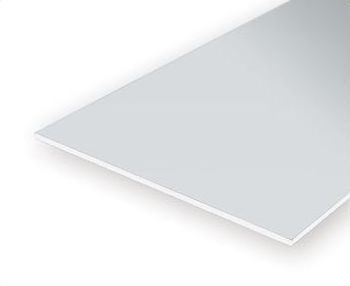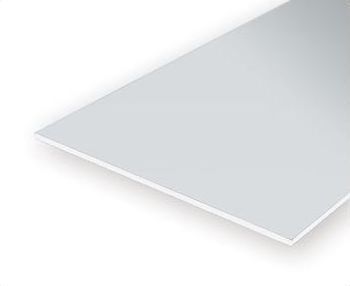
A white polystyrene sheet 2.0 mm thick. Material for bases, bulkheads and building your own parts from scratch.
Responsibility details are not available.
A thickness of two millimeters is on the thicker end of what is commonly used in modeling styrene. Thin sheet will bend under a finger, but this sheet stays flat even over a larger area, so it suits load-bearing parts of a build: bases under dioramas, bulkheads inside hulls and fuselages, tank floors, jigs, or building walls made from scratch. Unlike wood or cardboard, the material does not warp with moisture, which matters most for larger bases meant to stay flat for years.
The familiar score-and-snap trick reaches its limit here. You need to run the knife along a metal ruler many times over, until the groove reaches about halfway through the cross-section, and only then does the sheet snap cleanly. A fine-toothed saw is faster, leaving an edge that just needs squaring up with sandpaper laid on glass. Drilling and milling both work fine, just at lower speeds so the plastic does not melt.
Thin liquid plastic cement works like a weld: it flows into the joint, briefly dissolves both surfaces, and once the solvent has evaporated, holds the joint as a single piece. Clamp the parts and leave them undisturbed until the solvent is gone, or the surface will sink in over time. The material is the same family as kit plastic, so it accepts the same paints, fillers and engraved lines. The white surface also lets you draw directly on the sheet with a pencil and simply wipe the sketch off afterward. Do not throw away offcuts — even small pieces serve as corner reinforcements and small shims.
Naši poradci a znalci sortimentu jsou připraveni odpovídat na Vaše dotazy (Po–Pá, 8–18 hod).
Zeptejte se na co potřebujete, odpovíme co nejdříve.
Texts from customers in the advice section reflect solely the opinions and views of the customers. MNF trade s.r.o. does not approve or verify customer texts in advance.
There are no questions here yet. Be the first to ask!