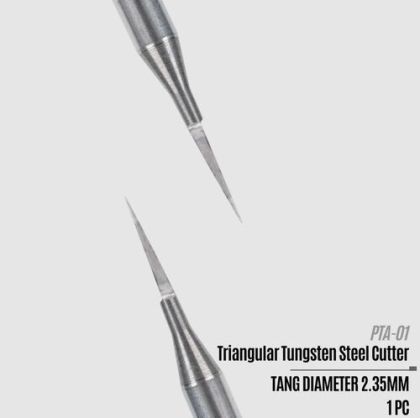
A micro drill is only the drive — what actually happens to the material is decided by the accessory in the collet. Burrs of various profiles and fine engraving points fit there, all of them here on a 2.35 mm shank, and the shape of the tool determines the result: a cylindrical burr opens a hole out to a straight wall, a tapered one with a rounded end breaks an edge and countersinks a mouth, a triangular one cuts a narrow groove, and a set of diamond points serves for engraving and refining a shape.
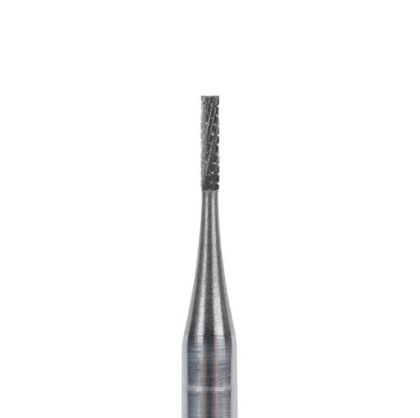
It opens a hole out to a straight cylindrical wall and flattens its bottom. It suits seats for magnets, pins and tubes, where a part has to sit exactly and square.
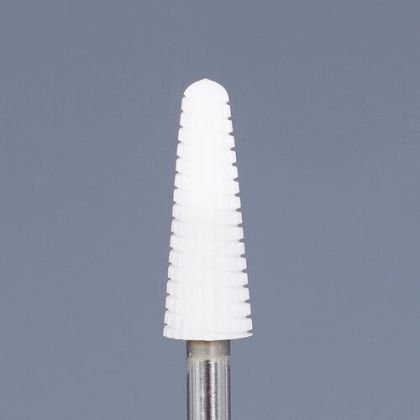
The tapered profile breaks an edge, countersinks a mouth and creates a smooth transition, while the rounded end avoids cutting a sharp step into the bottom. It earns its place at gun muzzles and exhausts, where the rim should look thin — the countersink creates the impression of a tube wall.
Three flutes on a tapered body cut a narrow groove and can be run along an edge. The tungsten steel version copes with cured two-part putty, which blunts ordinary steel quickly.
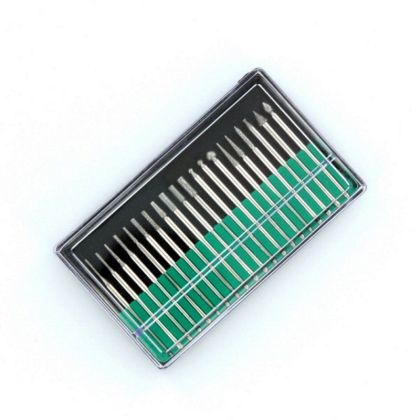
A set of twenty shapes for engraving, levelling small blemishes and working hard materials. They cut abrasively, so they remove material gradually and stay easy to control.
The most important figure is shank diameter. Everything in this category is 2.35 mm, the common modelling standard, so check that the collet of your micro drill takes it, otherwise the tool is badly held and runs out of true. The second is speed: low on styrene so the material does not melt, higher on hard compounds with a light feed. The third is clamping the work, because a rotating burr can snatch a loosely held part out of your hand. Use a vice from stands and clips.
If all you want is a hole with no further shaping, a tool from pin vices will do the job.