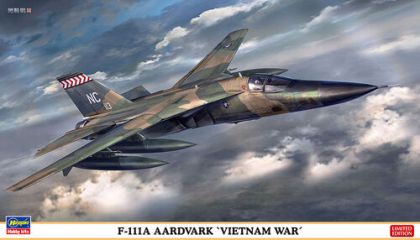
Hasegawa F-111A Aardvark Vietnam War 1:72 is an unassembled plastic kit of the original production version of the American bomber with variable-geometry wings, in an edition with decals for aircraft deployed in the Vietnam War.
Responsibility details are not available.
An unassembled and unpainted injection-molded plastic kit of the General Dynamics F-111A in 1:72 scale from Hasegawa. It is a limited edition with a special decal sheet: the decals offer two aircraft of the 474th Tactical Fighter Wing of the US Air Force (the 429th and 430th Squadrons) in Southeast Asia camouflage with a black underside, that is, machines from the Vietnam War. The tooling is older but excellently done — fine engraved panel lines, a detailed cockpit, pylon stations. The package holds drop tanks, a multiple ejector rack, a gun pod and one missile; conventional bombs and air-to-air missiles are not in the kit. The wing is built in the forward (spread) position — the extended slats and flaps do not allow it to be swept back.
The F-111A was the original production version of the two-seat supersonic tactical bomber F-111, nicknamed the Aardvark after its long nose. Its characteristic feature is the variable-geometry wing: spread for takeoff and landing, swept for high-speed flight. Thanks to the terrain-following radar, which automatically followed the ground, the F-111 flew extremely low and fast even at night and in bad weather — which is why it could make its way to the target alone and without escort. The crew had no ejection seats: instead, the whole sealed cockpit with both men separated from the aircraft as a single escape module, came down on a parachute, with bags to cushion the impact that worked as floats on water, and the module then served as a floating shelter. Compared with the later D and E, the A version had the original engines, analog avionics and the earlier air intakes. The F-111A was committed to combat in Vietnam in 1968 and again at the close of the war.
Glue with thin cement for polystyrene run in by capillary action. Watch the fuselage seams and the air intakes — fill and sand them before painting. Finish the cockpit before you close up the fuselage and, with a tricycle landing gear, test the balance in advance and add weight in the nose if needed. Spray the Southeast Asia camouflage with an airbrush over a primer and do the soft transitions freehand or with masking held off the surface. Lay a gloss coat under the decals, then a wash into the panel lines and a final matte coat.
The model is supplied unassembled and unpainted. Glue, paints and accessories are not included in the package, unless stated otherwise.
Naši poradci a znalci sortimentu jsou připraveni odpovídat na Vaše dotazy (Po–Pá, 8–18 hod).
Zeptejte se na co potřebujete, odpovíme co nejdříve.
Texts from customers in the advice section reflect solely the opinions and views of the customers. MNF trade s.r.o. does not approve or verify customer texts in advance.
There are no questions here yet. Be the first to ask!