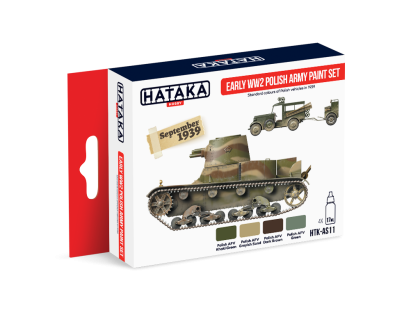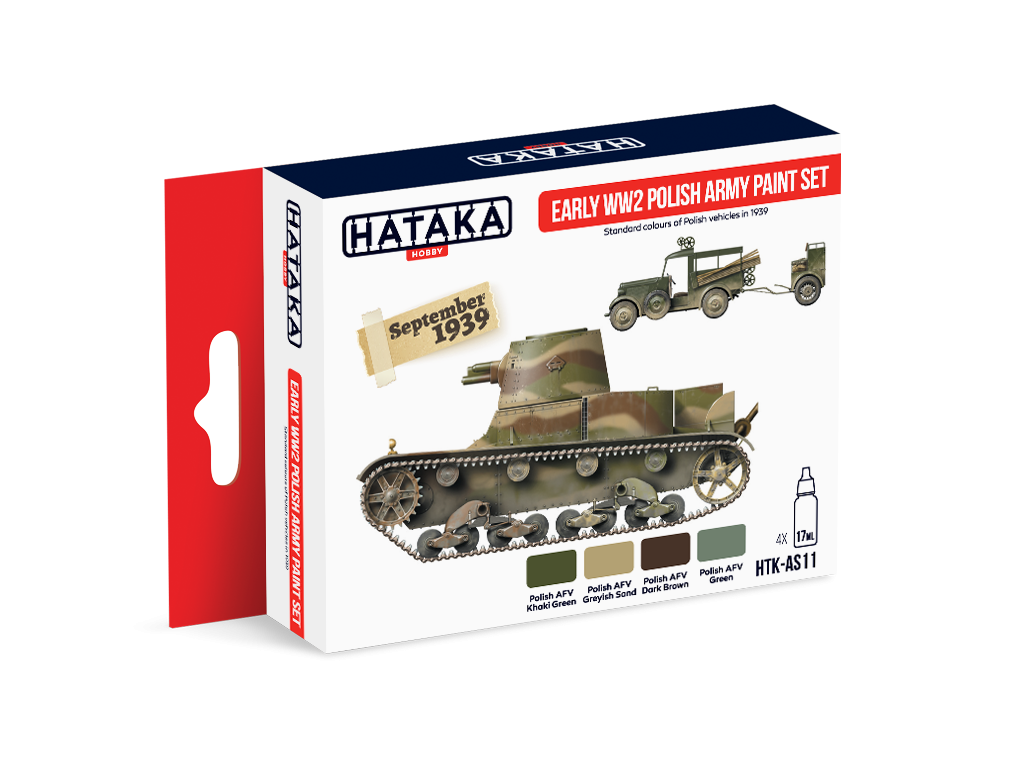
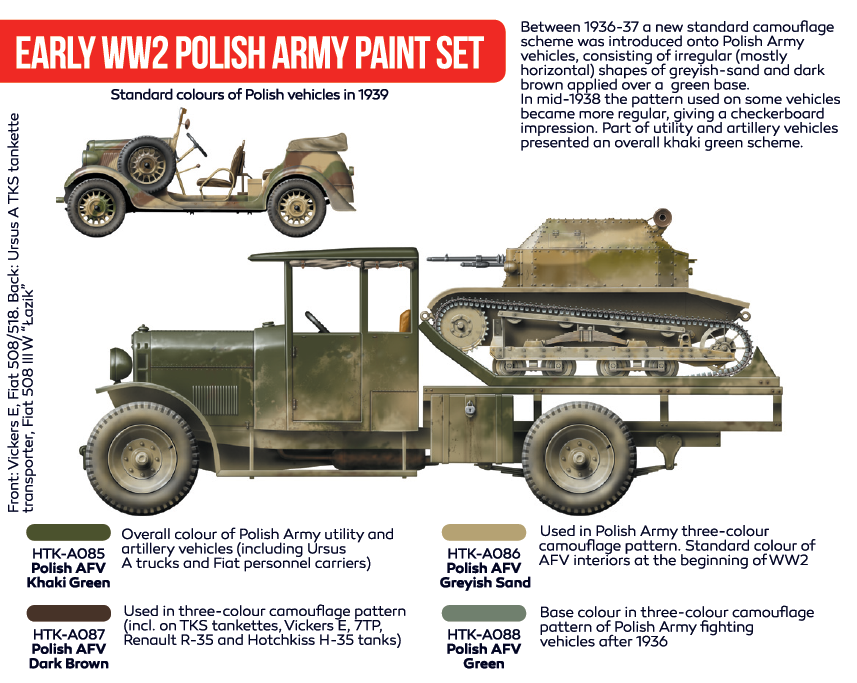
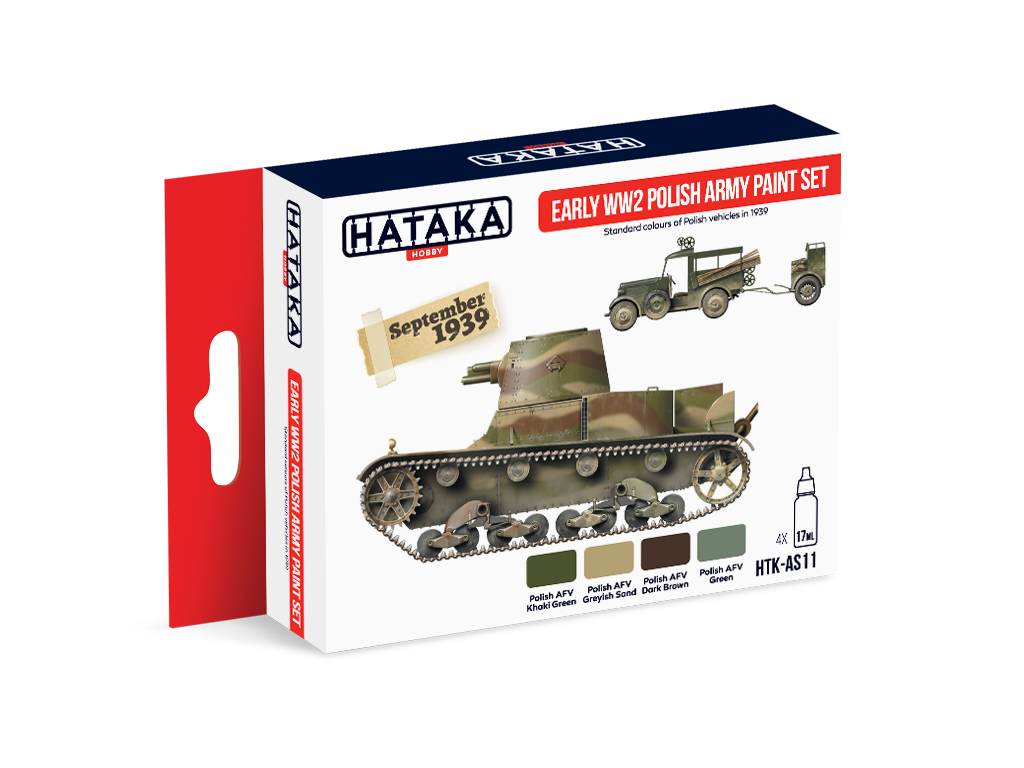
Four shades of Polish prewar armored vehicles, including the base and the additional colors of the three-tone camouflage introduced after 1936.
Responsibility details are not available.
In the late 1930s the Polish army adopted an unmistakable camouflage pattern: irregular patches in three tones with soft transitions, which broke up the outline of a vehicle. Green was the base, over it came grayish sand and dark brown. This set supplies all three plus the khaki carried by utility and artillery vehicles in a single-color finish.
The pattern was carried by TKS tankettes, British Vickers Type E, the home-built 7TP light tanks and the French Renault R-35 and Hotchkiss H-35 machines the Polish army operated. The 7TP in particular is a rewarding subject: the twin-turret and single-turret versions in bright three-tone camouflage are among the most striking armored vehicles of 1939. The grayish sand color has a double use: besides the patches on the outside it also suits the interior, so one bottle solves an open model and its inside alike.
There is one more thing that goes with Polish machines of 1939: dust. The vehicles moved along unmade roads, and in photographs of the day the individual tones of the camouflage often merge under a coating of dust. A fine veil applied at the end therefore belongs to the build just as much as the pattern itself.
Naši poradci a znalci sortimentu jsou připraveni odpovídat na Vaše dotazy (Po–Pá, 8–18 hod).
Zeptejte se na co potřebujete, odpovíme co nejdříve.
Texts from customers in the advice section reflect solely the opinions and views of the customers. MNF trade s.r.o. does not approve or verify customer texts in advance.
There are no questions here yet. Be the first to ask!