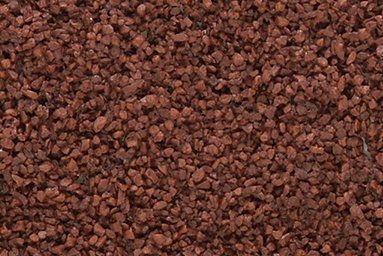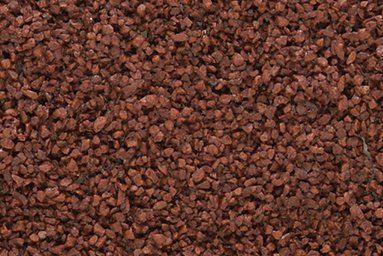
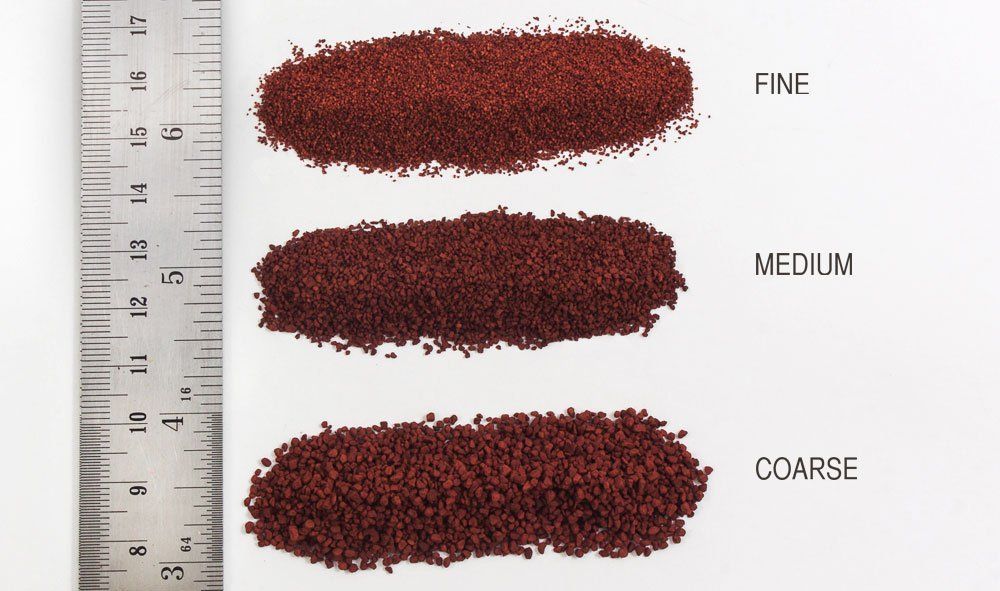
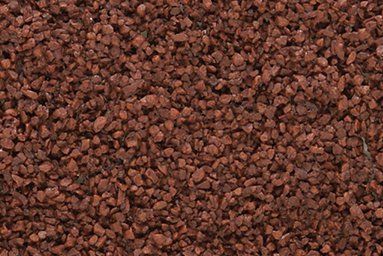
Rust-colored stone in a coarse grade for large scales and industrial scenery.
Responsibility details are not available.
The coarse grade is the answer to a simple problem: the larger the scale, the larger a single stone has to be so that the result looks right. On a garden railway, on park lines or in a diorama with equipment at one to thirty-five, a fine scatter would merge into a shapeless surface, whereas distinct grains give the surface a texture the eye picks out even in a photograph.
The shade refers to the ore lines and ironworks, where waste rock and furnace dust were ground into the bed over the years. The same color belongs to a weathered spoil heap above an adit or a tip by a crusher. A modeler will use it everywhere the scenery is meant to look industrial and neglected, and off the track as well – on the access road to a workshop, say, where trucks have churned coarse gravel into ruts.
Coarse grain holds less well on its own, so it pays to coat the base with a thin layer of glue first and to scatter the material into it. You then carry out a second fixing from above, by dripping on thinned glue through a wetting agent. On very coarse areas two doses of glue tend to be needed, otherwise the uppermost grains come loose once dry.
The dry material can be sieved before use and two different grain sizes obtained from one bag. The finer fraction then suits the places where the surface is to pass into the surrounding terrain, while the coarser stays where the scene is meant to be most broken up. A transition between the two sizes reads more naturally than a sharp boundary.
Naši poradci a znalci sortimentu jsou připraveni odpovídat na Vaše dotazy (Po–Pá, 8–18 hod).
Zeptejte se na co potřebujete, odpovíme co nejdříve.
Texts from customers in the advice section reflect solely the opinions and views of the customers. MNF trade s.r.o. does not approve or verify customer texts in advance.
There are no questions here yet. Be the first to ask!