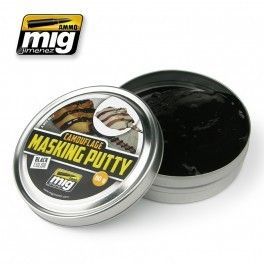
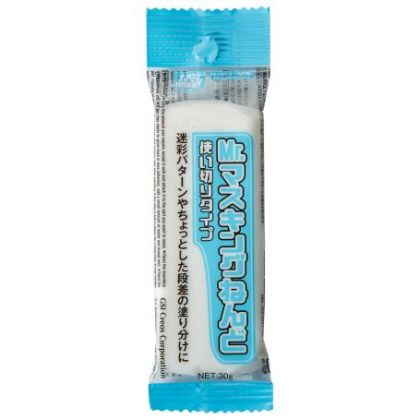
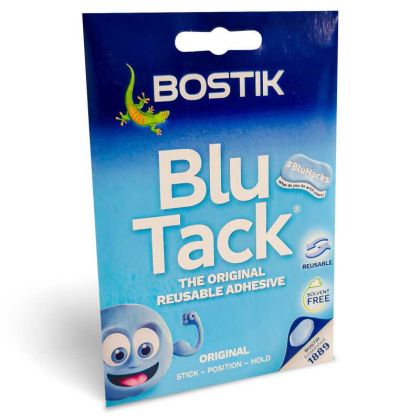
Mouldable masking putty answers the one job tape cannot do, which is a free, irregular curve. You roll it between your fingers into a thin worm, lay it along the line the camouflage pattern will follow and press it down. It holds where it is put, can be reshaped as often as you like and lifts off cleanly after spraying. Modellers reach for it mainly on camouflage schemes with a soft sprayed transition, and on the hard-edged irregular patterns where a straight roll of tape would fight the shape all the way.
The thickness of the worm sets the hardness of the boundary: pressed flat against the surface it gives a sharp edge, lifted very slightly it lets paint creep underneath into a soft transition. That single control is why putty so often replaces a stencil on camouflage work. Tapes, flexible grades and other materials are in the parent heading masking supplies; straight boundaries belong to masking tapes, and small raised details to masking fluid.