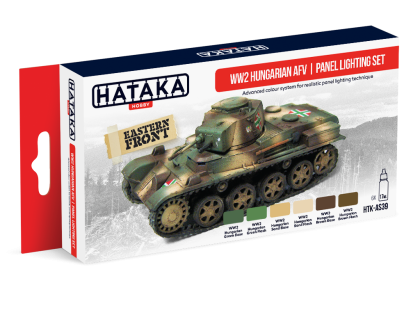
Three base tones of Hungarian army camouflage of the Second World War, each paired with its lightened counterpart for accentuating panels and edges.
Responsibility details are not available.
During the Second World War the Hungarian army used a conspicuous three-color pattern of green, sand and brown on its vehicles. It was carried by machines of domestic design, that is the Turan medium tanks, the light Toldi, the Zrinyi self-propelled guns and the Nimrod anti-aircraft vehicles, and the pattern is among the most striking that appeared in the Europe of that time.
The lineup is built differently from an ordinary palette. For each of the three tones it also holds a lightened counterpart, so three pairs arise. The base is applied overall, and the lighter tone then only in the middle of the larger surfaces and on the upper edges, where daylight would fall.
A model is many times smaller than a real vehicle and the shadows fall on it differently. The eye therefore perceives a uniformly painted surface as flat and dead. Lightening the centers of the panels evens that difference out and the model begins to come across as though it had real dimensions. That is exactly why the pairing of base and lightening is useful even where one shade would do.
Given that the pattern combined all three colors on one vehicle, a whole column can be built from the lineup without buying further tones.
Naši poradci a znalci sortimentu jsou připraveni odpovídat na Vaše dotazy (Po–Pá, 8–18 hod).
Zeptejte se na co potřebujete, odpovíme co nejdříve.
Texts from customers in the advice section reflect solely the opinions and views of the customers. MNF trade s.r.o. does not approve or verify customer texts in advance.
There are no questions here yet. Be the first to ask!