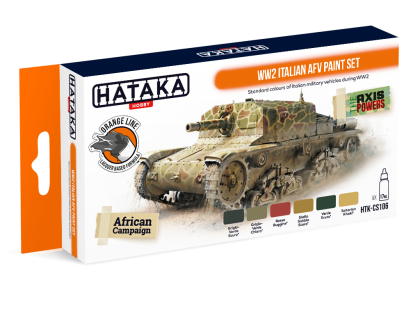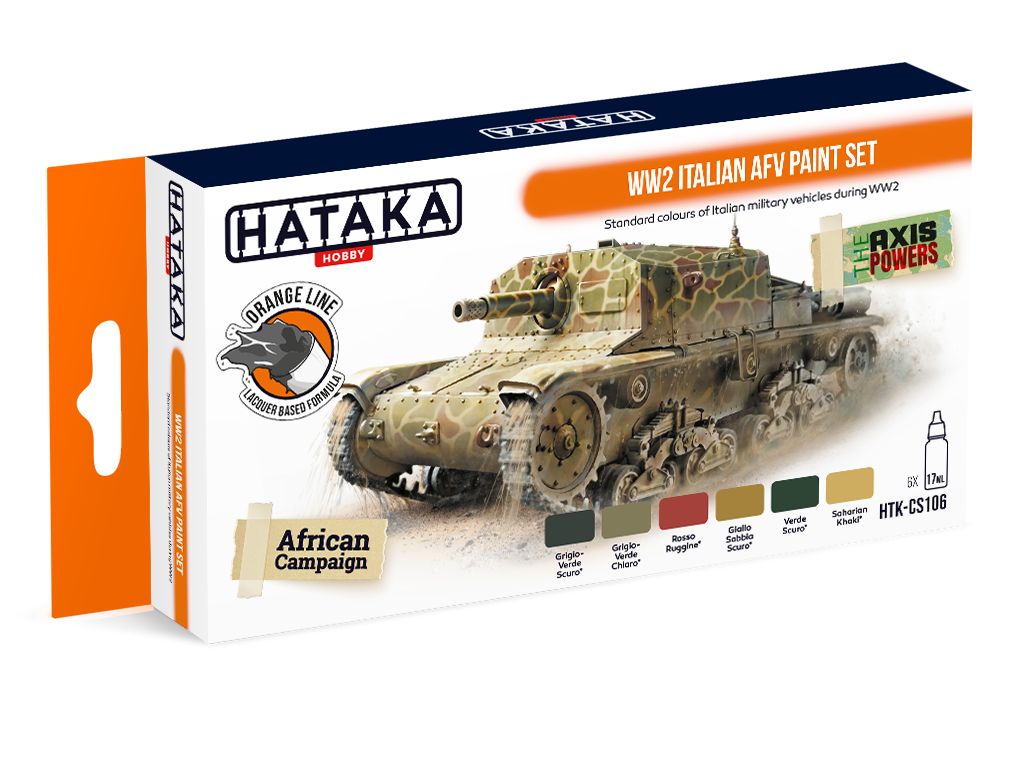
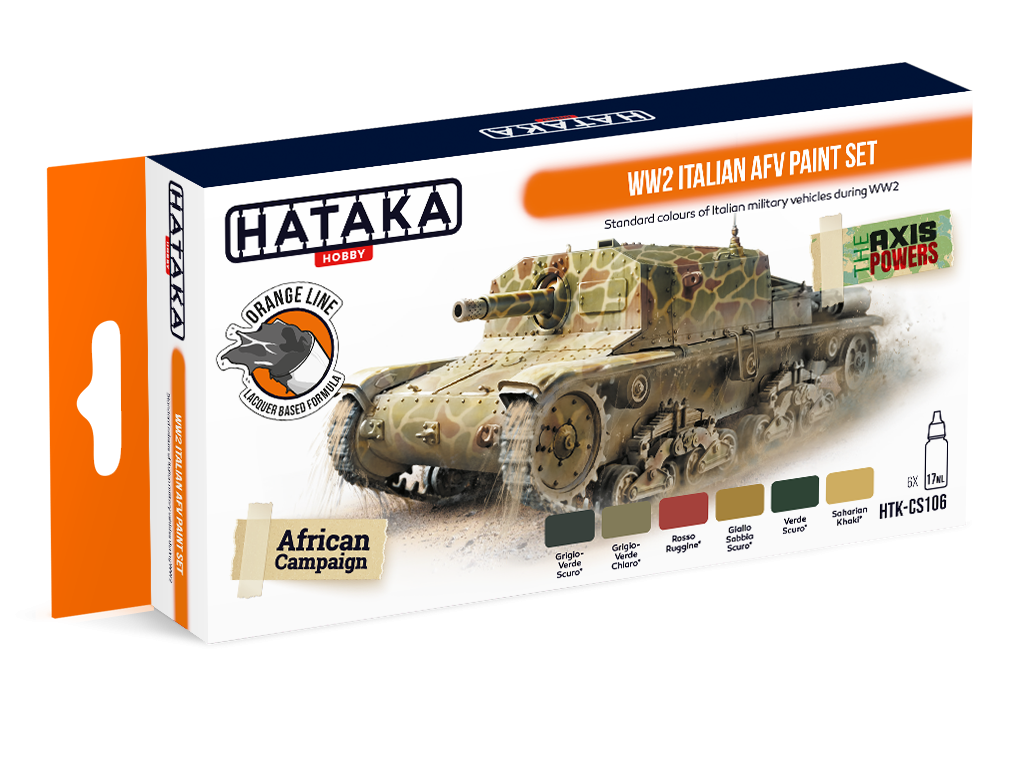
Six lacquer shades for Italian ground equipment: the basic gray-green tones, rust red, dark green, desert khaki and sand for the so-called amoeba camouflage.
Responsibility details are not available.
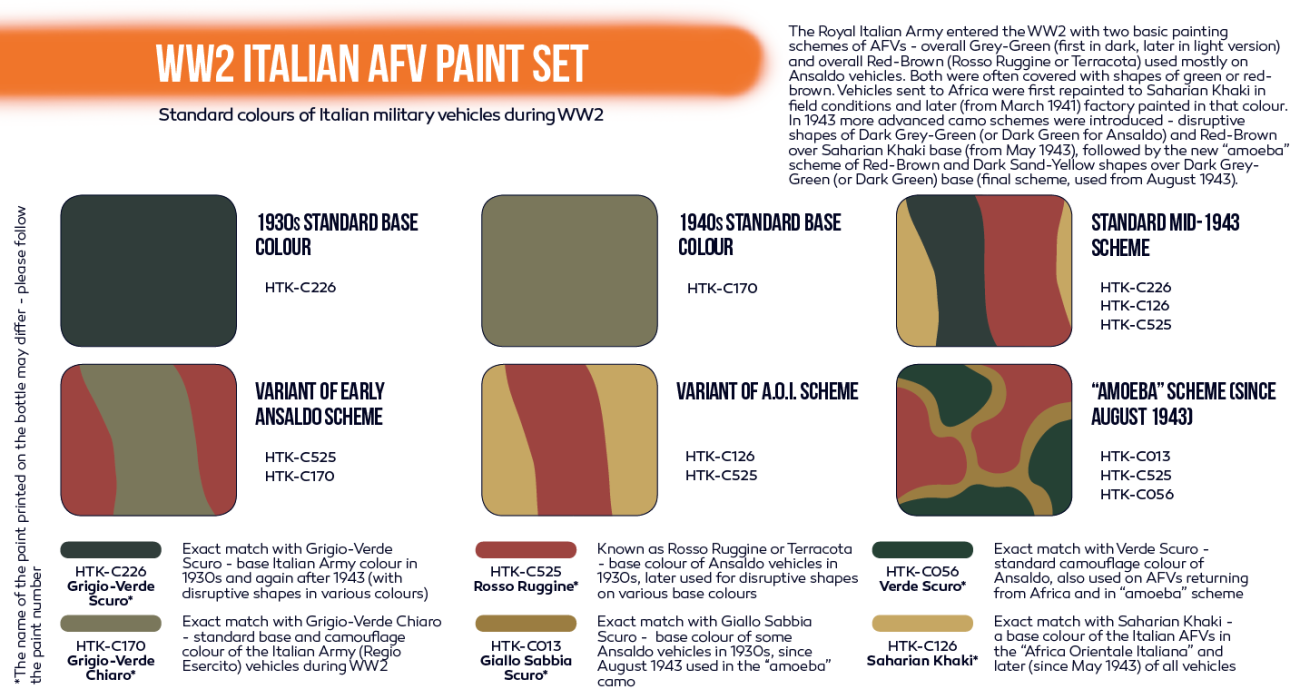
The Italian army worked with a fairly narrow palette, but combined it into striking patterns. The lighter gray-green served as the standard base and camouflage shade of vehicles throughout the Second World War. A darker variant of the same tone supplemented it in the 1930s and again after 1943, usually as a base onto which scattered shapes in other colors were applied. It is this pair that forms the core of the set.
The rust red, known as Rosso Ruggine or terracotta, covered machines from Ansaldo production in the 1930s and later appeared only as patches over other base colors. The dark sand also belonged to the prewar Ansaldo machines and from August 1943 became part of the striking amoeba camouflage with its rounded lobes. The dark green served as a camouflage color at the same firm, among other places on vehicles returned from Africa. The last bottle is the Sahara khaki, the base shade of equipment in Italian East Africa, which from May 1943 was extended to all vehicles.
The range is solvent-based and very durable once dry, which suits ground equipment: the coat will stand up to edge highlighting with pencils, to oils and to pigments without lifting under them. The thinner has to be a lacquer thinner. The amoeba pattern is best sprayed freehand at low pressure, because the soft edge of the patch matches the way the camouflage was applied in the field.
Naši poradci a znalci sortimentu jsou připraveni odpovídat na Vaše dotazy (Po–Pá, 8–18 hod).
Zeptejte se na co potřebujete, odpovíme co nejdříve.
Texts from customers in the advice section reflect solely the opinions and views of the customers. MNF trade s.r.o. does not approve or verify customer texts in advance.
There are no questions here yet. Be the first to ask!