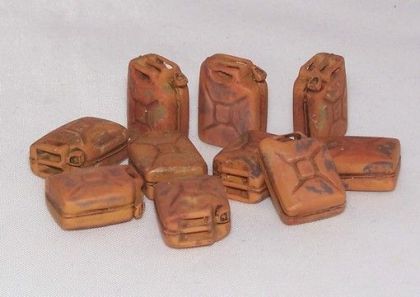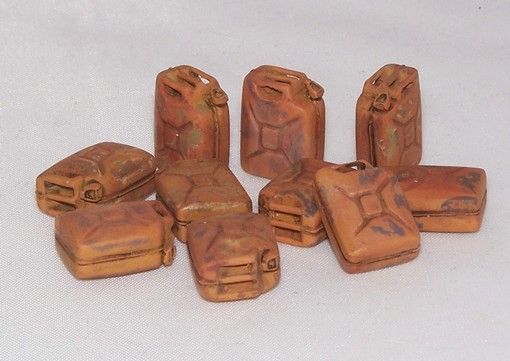
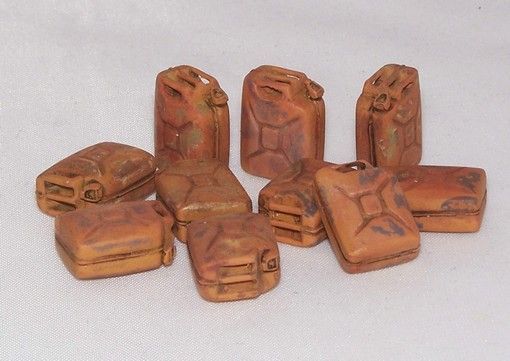
Burned-out German jerrycans in 1:35 scale, ten pieces in a blister pack. The vessel with three handles and a cross-shaped swage belonged to the equipment of practically every vehicle.
Responsibility details are not available.
The German standard twenty-liter can appeared in the second half of the 1930s and became one of the most successful pieces of field equipment there has ever been. Three handles made it possible to carry two vessels in one hand and to pass them along a chain, the cross-shaped swage gave the wall its stiffness and an air pocket at the top let a full can float. The Allies took the design over almost unchanged. A charred example beside a wreck is therefore recognized by every viewer and gives a scene an instantly identifiable detail.
The blister pack holds ten castings of these vessels.
The procedure is called chipping and it rests on two layers. First lay on a paint in a rusty or burned shade, once dry go over it with a layer of hairspray or a product intended for the purpose, and only then spray the top shade. After a while moisten the surface with water, let it act briefly and break the top layer with the tip of a stiff brush or a toothpick in the places where an edge would rub: around the handles, on the bottom and on the raised parts of the swage. The chipped paint then has the irregular edge that cannot be painted with a brush.
Finally add a bluish to straw cast in the places where the sheet metal really burned.
Leave one vessel undamaged and stand it apart from the charred group. The contrast between an intact and a burned piece says more about what happened in the scene than ten identically damaged castings side by side.
Naši poradci a znalci sortimentu jsou připraveni odpovídat na Vaše dotazy (Po–Pá, 8–18 hod).
Zeptejte se na co potřebujete, odpovíme co nejdříve.
Texts from customers in the advice section reflect solely the opinions and views of the customers. MNF trade s.r.o. does not approve or verify customer texts in advance.
There are no questions here yet. Be the first to ask!