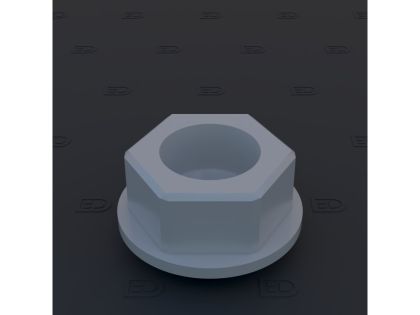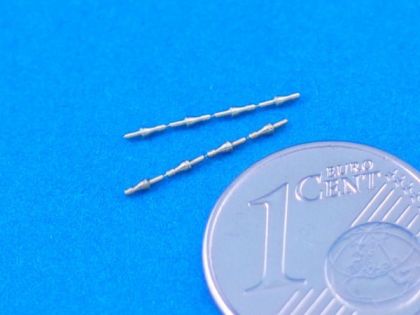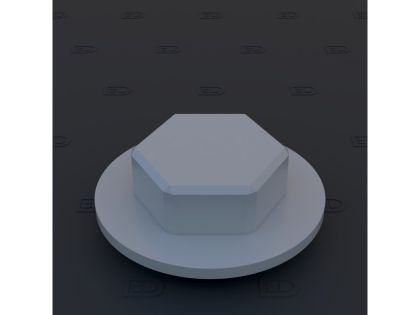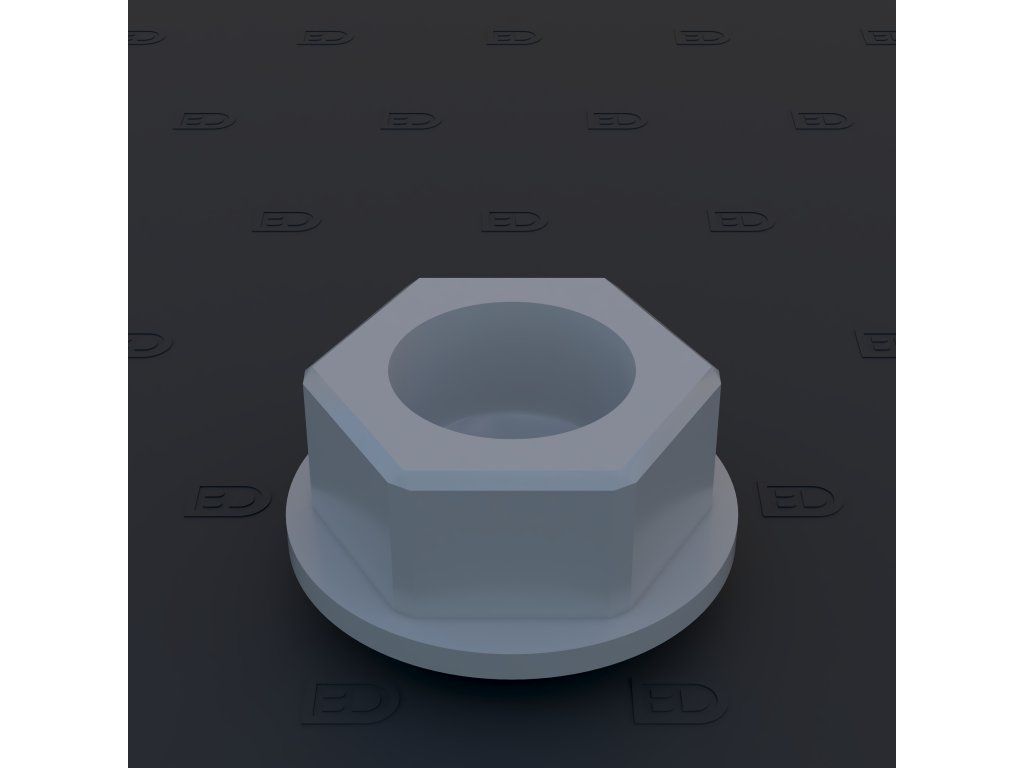
The finest member of the flange family, 0.5 mm in diameter. The collar under the hex seats on engine covers as well as on bodywork parts.
Responsibility details are not available.
A hex with a flange stands or falls on what it seats against. The typical failure starts with an unfinished part: a remnant of the mold parting line, a burr from the gate or a slightly convex surface is enough for the flange to seat on one side only. The joint then sits crooked, and seen from the side a shadow under the rim gives it away, a shadow the paint cannot cover.
Before you start drilling, run fine abrasive paper or a flat scalpel blade along the surface around the spot. Level the parting line and blow the dust away so that nothing is trapped under the rim. On rounded surfaces it is right to create a small flat, otherwise the flange seats on a curve and the position of the joint changes at every touch.
Five tenths of a millimeter is the lower limit at which the flange is still recognizable. It is used where the joint should look delicate and still be noticeable: flange bolts on engine covers, the mounting of plastic bodywork parts, small tank brackets. The light marking means that the head has a lower profile than the full version of the same shape.
The manufacturer offers the flanged hex in graded head heights, from the lowest through the middle to the full one. They can be combined on a single model: lower heads on bodywork and covers, higher ones where the joint should read from a greater distance. This piece is from the lowest version.
Naši poradci a znalci sortimentu jsou připraveni odpovídat na Vaše dotazy (Po–Pá, 8–18 hod).
Zeptejte se na co potřebujete, odpovíme co nejdříve.
Texts from customers in the advice section reflect solely the opinions and views of the customers. MNF trade s.r.o. does not approve or verify customer texts in advance.
There are no questions here yet. Be the first to ask!