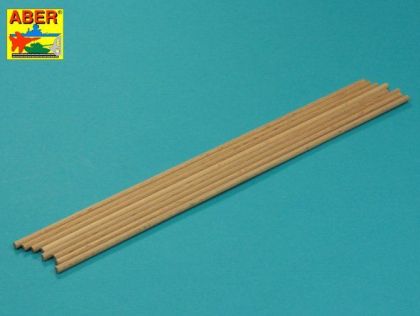
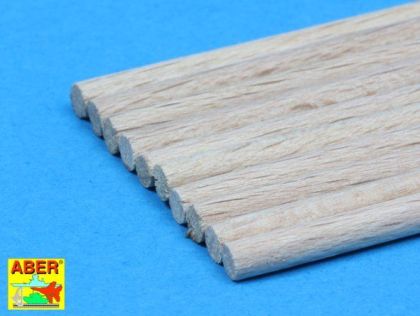
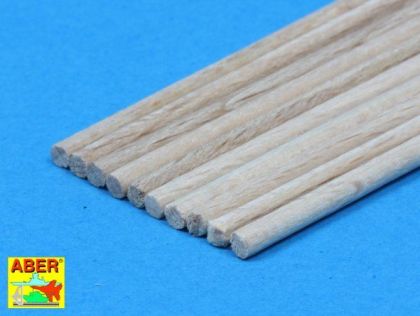
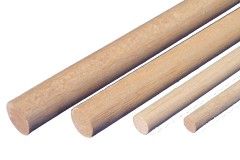
Dowel is wooden stock with a round section. The finer sizes of 2, 3, 4 and 5 mm come several pieces to a pack in 250 mm lengths, while heavy beech bar is supplied in 12 and 13 mm diameters, 400 mm long. On a model it becomes ship masts and spars, stanchions and posts, axles and shafts, handles, fence stakes and structural parts of a scene.
Beech is hard and strong, so a length carries a load while staying light, and wood can be sanded into a smooth taper, which neither metal nor plastic will do.
For round parts, wood offers two things metal and plastic cannot. It can be sanded to a taper, so a uniform length becomes a mast that narrows steadily towards the top exactly as the real one does. And it has grain of its own, so after a coat of clear and no paint at all it still reads as timber, which is useful for beams, stakes and deck fittings.
The 2 and 3 mm sizes are spars, railing stanchions and small posts. Four to five millimetres make masts for smaller ship models and structural members. The heavy 12 and 13 mm beech bar is more construction stock, for display bases, stands and large scenic elements.
A mast or spar is tapered by sanding. Roll the dowel between your fingers and run the abrasive along it, never across, and you get a smooth cone with no flats in it. Work from a coarser grade to a fine one and keep checking that the taper is even all round. Abrasives are listed under sanding tools.
Dowel drills well, but the bit wants to skate off the curved surface, so start it with a dimple made by a knife point. Hold joints with PVA or cyanoacrylate. For square wooden sections, carry on to the beech blocks, and for the whole survey of timber to the wooden profiles.
Masts and spars are the commonest reason to buy dowel at all, so the kits behind those builds are in ship model kits.