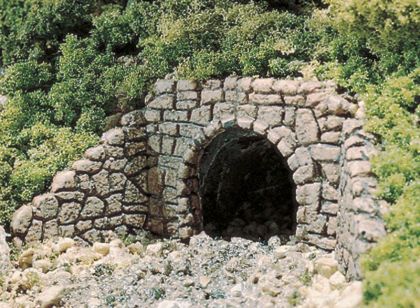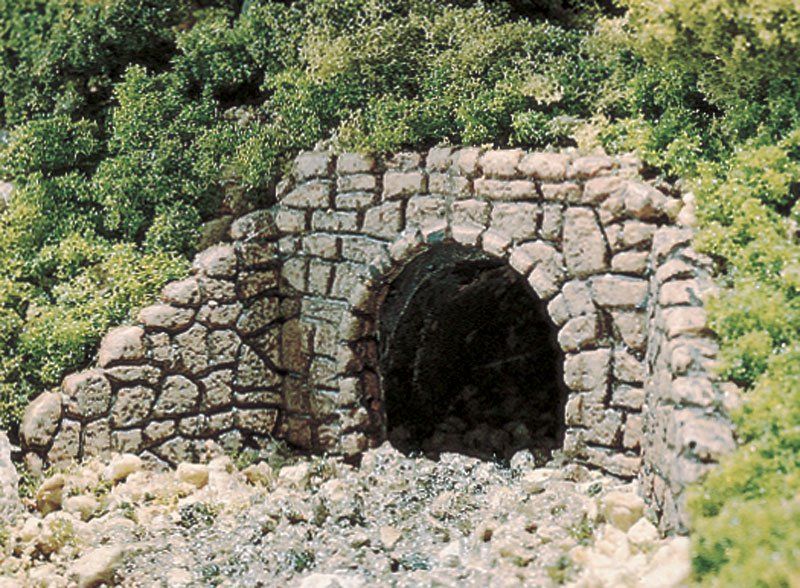
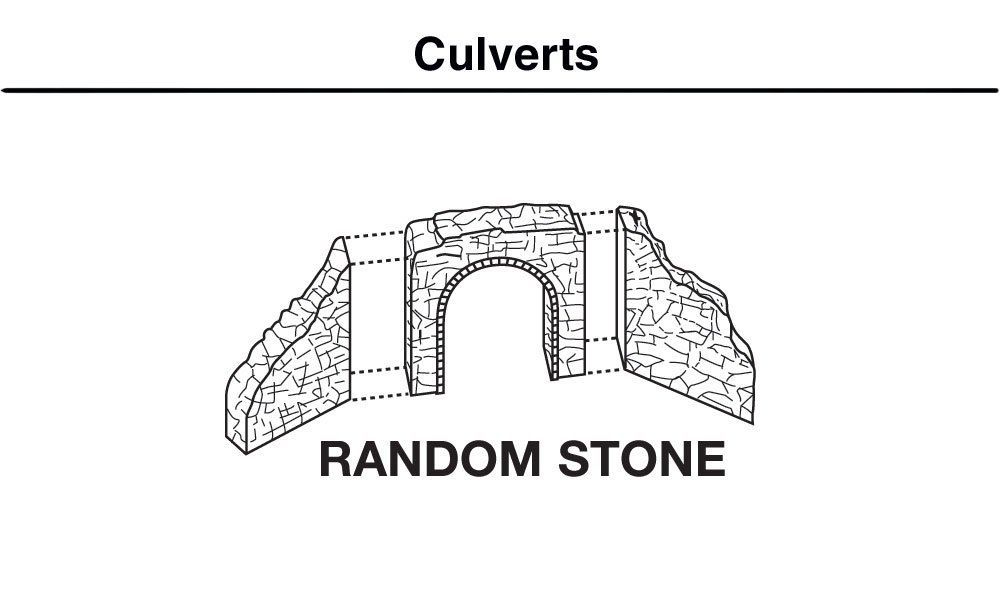
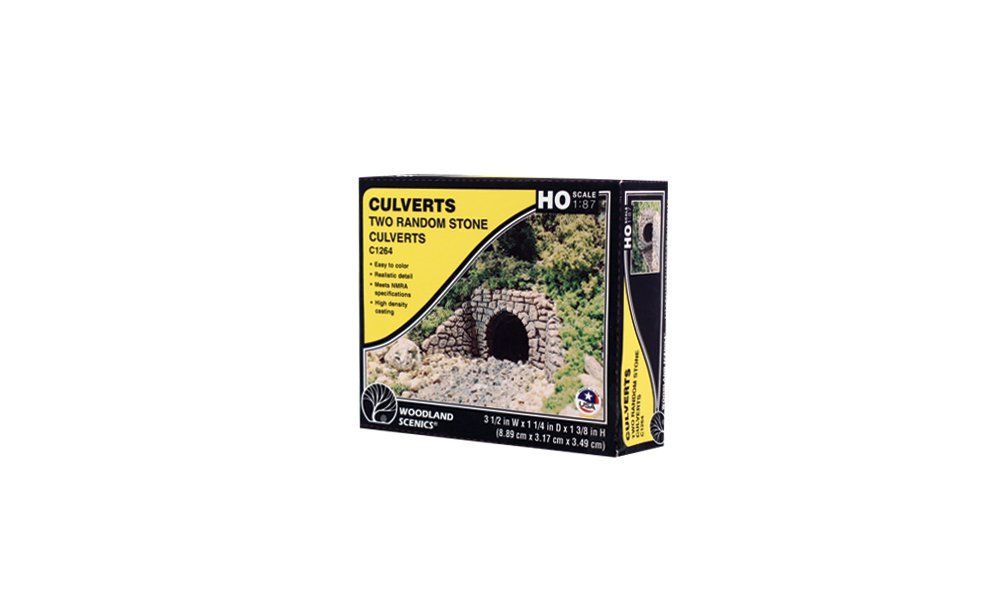
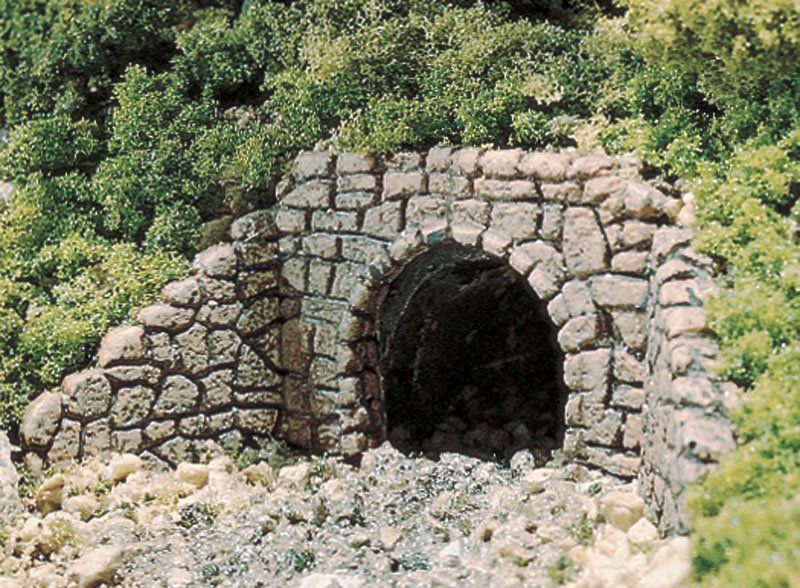
A casting of a culvert of undressed quarried stone for HO. Roughly 8.89 cm wide, 3.17 cm deep and 3.49 cm high.
Responsibility details are not available.
The irregular arrangement of stones that a builder put together from whatever the nearest quarry or riverbed gave belongs among the oldest ways of building walls at all. The stones were laid dry or in lime mortar, the larger pieces at the bottom, smaller wedges into the gaps, and the resulting face never has two joints the same. On railroads such stonework appeared mainly at smaller objects, where it was not worth hauling in dressed blocks: at retaining walls, at culverts and at the approaches to small bridges.
The casting carries precisely such a disordered texture. With a width of approximately 8.89 cm it is the broadest piece of the whole line of culverts and in the ratio 1:87 it spans a noticeably wider channel than its sister versions. The depth is roughly 3.17 cm and the height 3.49 cm, so the object fits even into a lower embankment, where a higher arch would stick out above the terrain around.
A culvert that does something in the landscape looks the most natural. Lead a dry or a watered channel to it, leave settled gravel and washed-up debris on the upstream side and, on the outflow, a scoured hollow instead. A small deposit of leaves at the inlet and a worn footpath along the crown of the roadbed will do the rest of the work for you.
Naši poradci a znalci sortimentu jsou připraveni odpovídat na Vaše dotazy (Po–Pá, 8–18 hod).
Zeptejte se na co potřebujete, odpovíme co nejdříve.
Texts from customers in the advice section reflect solely the opinions and views of the customers. MNF trade s.r.o. does not approve or verify customer texts in advance.
There are no questions here yet. Be the first to ask!