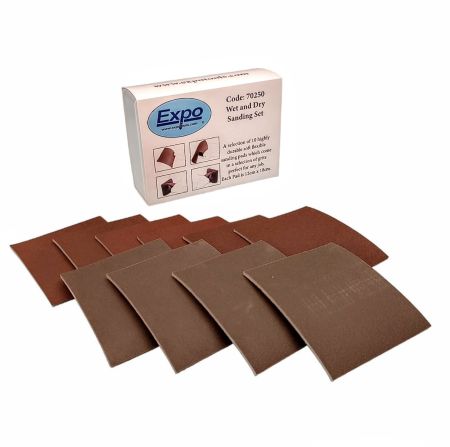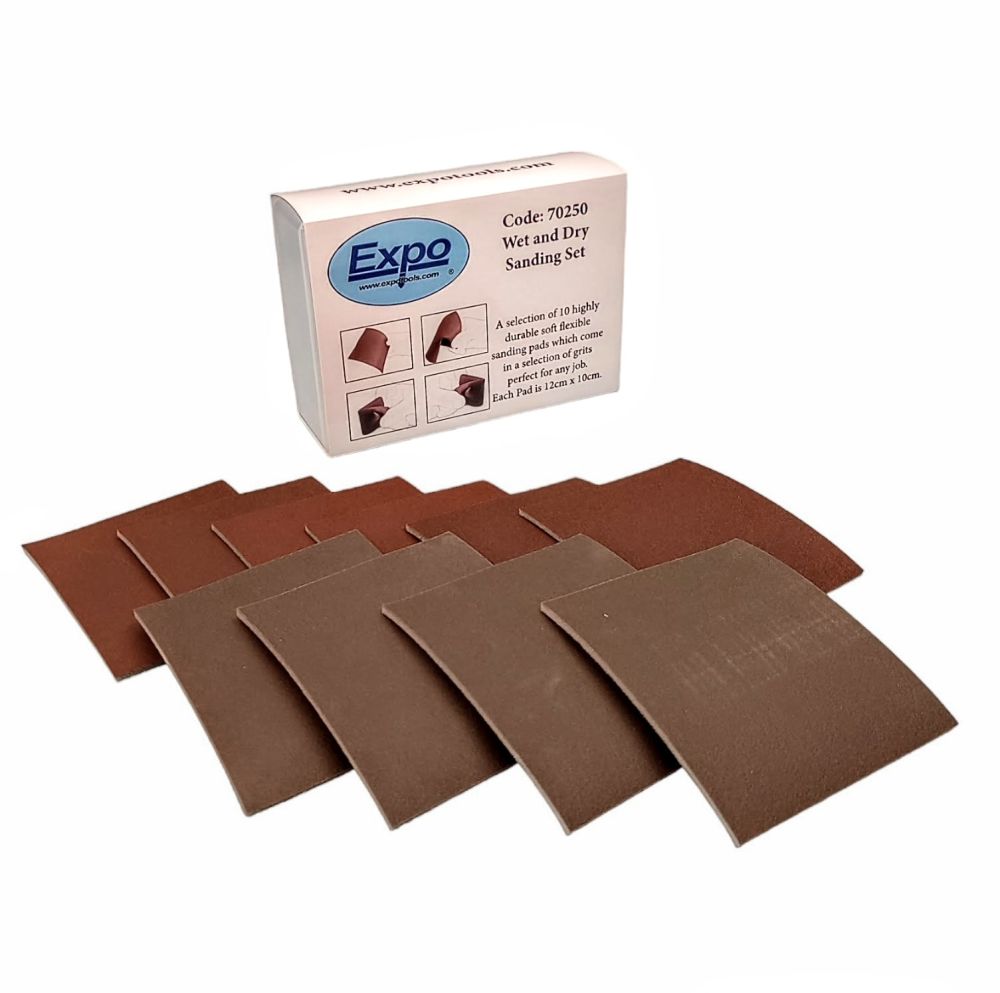
Ten flexible sanding pads in four grits, usable dry and with water alike.
Responsibility details are not available.
The package holds ten sanding pads in all, divided by grit: two of grit 150, two of grit 180, two of grit 220 and four of the finest, grit 280. This order matches the usual procedure, in which a coarser degree knocks down a parting line or the remains of a sprue nub and each further one merely erases the traces of the previous one.
The marking for wet as well as dry sanding means that a pad will stand up to water. Wet sanding has two advantages: the dust gets neither into the air nor into the lungs, and the surface does not clog, so the abrasive lasts substantially longer than when working dry.
A pad is flexible, so it follows the curve of a fuselage, the transition of a wing into a fuselage or the shape of a helmet on a figure. On flat surfaces it is better, by contrast, to stick abrasive paper onto a hard block, otherwise the edges get unintentionally rounded. In the workshop it is therefore an accessory rather than a replacement for classic abrasive paper.
Once finished, the surface is rinsed off and left to dry, and only then does the base coat come in turn. Remains of dust under varnish show as a grainy surface which is far harder to remove than if the model had been washed straight away.
The coarsest degree takes material off thin edges very quickly, so it suits massive castings and the remains of sprue frames rather than anything else. The fine degrees, by contrast, prepare a surface so that after spraying not a trace of the abrasive remains.
Naši poradci a znalci sortimentu jsou připraveni odpovídat na Vaše dotazy (Po–Pá, 8–18 hod).
Zeptejte se na co potřebujete, odpovíme co nejdříve.
Texts from customers in the advice section reflect solely the opinions and views of the customers. MNF trade s.r.o. does not approve or verify customer texts in advance.
There are no questions here yet. Be the first to ask!