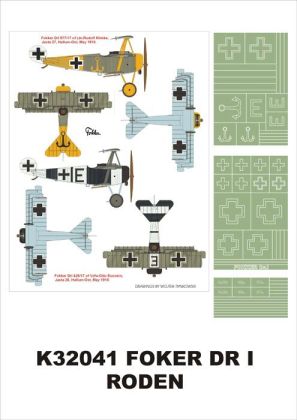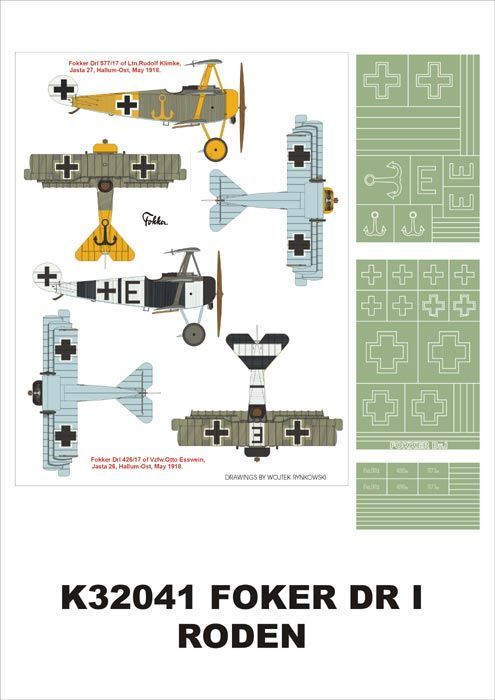
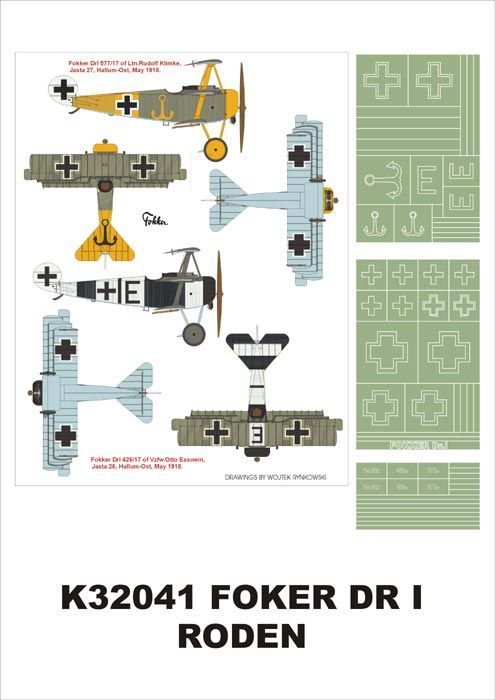
A set of three masks for the national insignia of the Fokker Dr.I triplane. There is no glazing mask in the box, because the aircraft has an open cockpit and no glazing at all.
Responsibility details are not available.
The Fokker triplane came about as an answer to the British Sopwith Triplane and reached front-line units in the autumn of 1917. The designer Reinhold Platz gave it a welded steel fuselage frame, thick plywood wings needing no external bracing and a rotary engine whose inertia lent the machine its famous rate of climb along with treacherous behavior in a left-hand turn. Its fame came above all from Jasta 11, where it was flown by that unit's best-known commander.
Because the cockpit is open and has no canopy, this set holds insignia masks only. From the factory the aircraft came in an olive shade streaked over a light base, so the surface looked striped, and the lower surfaces stayed light blue. On the wings and the fuselage crosses with broad white fields were still in use at that time, and spraying through a film renders them more precisely than a decal, whose carrier film would cast a shadow on ribbed fabric.
On a fabric surface it pays to press the film down with your fingers through a soft cloth so that it follows the ribs, and to spray perpendicularly from above in light coats. When the paint goes on from the side it gets under the edge of the mask where the fabric sags between the ribs.
The flying surfaces of a triplane sit close above one another, so the mask is laid on before they are joined. Once the model is assembled you can no longer reach the underside of the upper wing.
Naši poradci a znalci sortimentu jsou připraveni odpovídat na Vaše dotazy (Po–Pá, 8–18 hod).
Zeptejte se na co potřebujete, odpovíme co nejdříve.
Texts from customers in the advice section reflect solely the opinions and views of the customers. MNF trade s.r.o. does not approve or verify customer texts in advance.
There are no questions here yet. Be the first to ask!