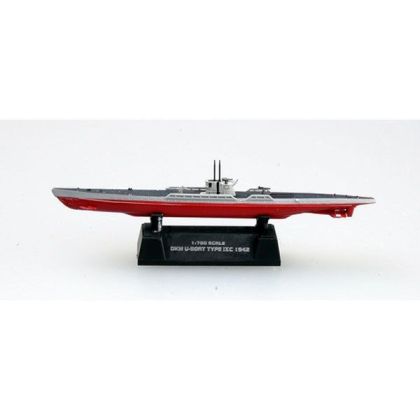
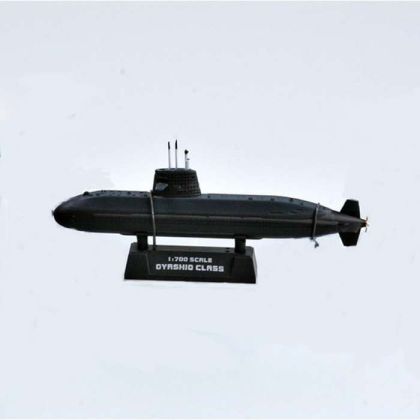
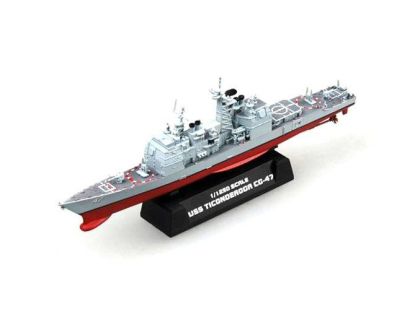
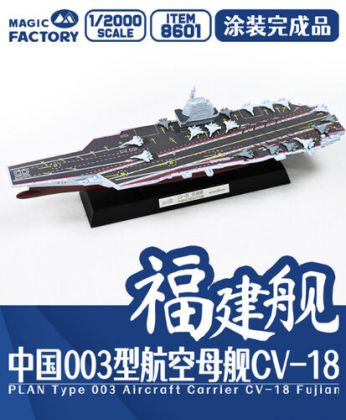
Ready-built ships and submarines solve the problem that always comes with naval subjects: size. An ocean-going vessel at a conventional modelling scale would never go on a shelf, which is why finished models are made in very small scales such as 1:700, 1:1250 and 1:2000, where an aircraft carrier fits the palm of your hand and a fleet fits one shelf. The range covers surface warships and submarines, assembled and surface-finished, with nothing to glue or paint.
Small scales change what a model can show you and what it cannot. Below we go through the trade-off and how to choose.
At 1:700 a cruiser measures around 200 mm and a submarine half that. This opens up something larger scales cannot offer: stand several vessels side by side and the differences in size and design concept become obvious. Smaller scales still go further and let you assemble a complete task group. The trade is superstructure detail — fine railings and radar are suggested rather than modelled.
Surface ships live on their superstructure, armament and flight deck, so a larger scale gives you more with them. A submarine is simple in form and therefore looks right even very small; what counts there is an accurate silhouette and clean paintwork along the hull.
If you want to compare vessels against each other, hold one scale and do not mix. A mixed case reads as a mistake even when every individual model is good, because the eye uses the neighbours as a ruler.
A full-hull vessel needs a plinth to sit level. Very small models display well several at a time on one base, where they read as a formation rather than as separate pieces.
To build a vessel yourself, with rigging belayed and photo-etched detail added, start with ship model kits and specifically ships in 1:700, the scale most used for fleet work. Submarines as kits are in submarine model kits and submarines in 1:700. The remaining ready-built groups are in collectors models.