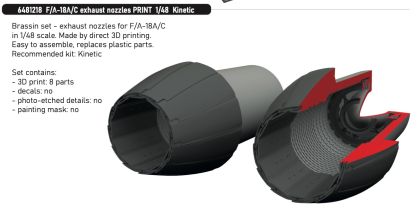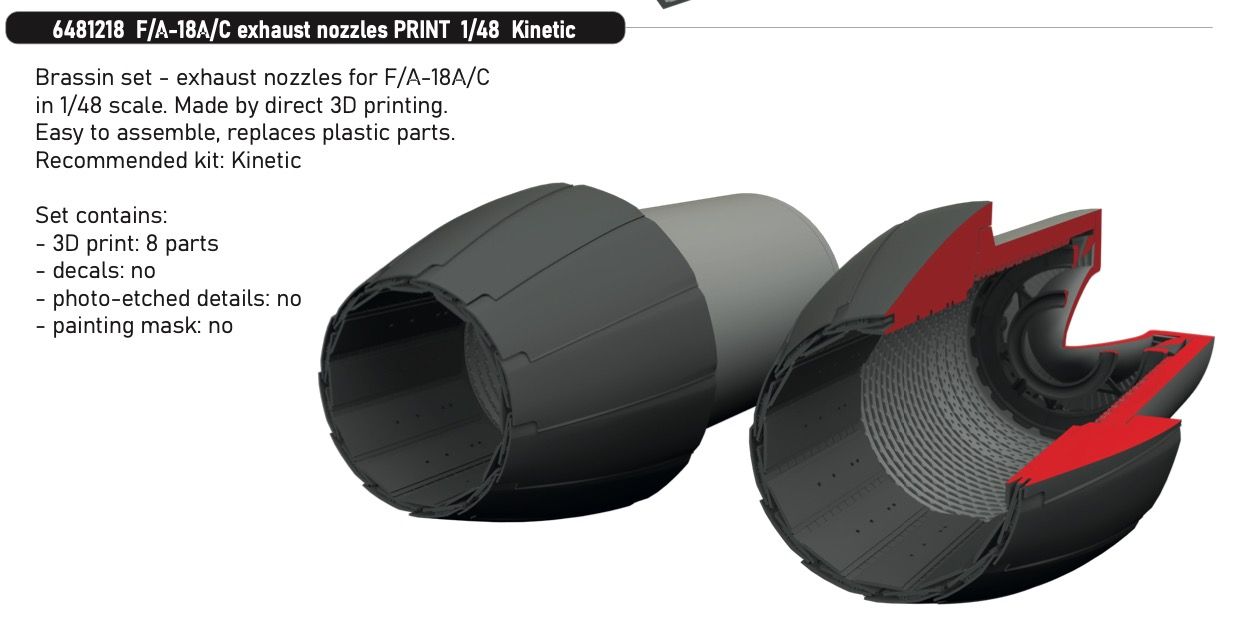
Printed exhaust nozzles for the first-generation carrier strike fighter in 1:48 scale. Intended for the kit from Kinetic.
Responsibility details are not available.
The original Hornet first flew in 1978 and from the mid-1980s served as an all-round carrier machine that could fight for the air and attack targets on the ground. The pair of engines end in movable nozzles made up of overlapping petals whose diameter changes with the operating mode.
This is exactly where the eye of anyone who walks around the display case from behind goes. A plastic solution has to be made from two halves, so after gluing a lengthwise seam is left that cannot be sanded out without damaging the fine edges, and the wall of the petals stays unnaturally thick.
This is not a small item but two complete tail ends including the inner surface, which cannot hide from view. Anyone building the model with the wings folded for a carrier deck scene gets the most conspicuous single improvement to the machine.
The inside of the petals is painted differently from the outside, usually in metallic shades with heat staining. It is sprayed before being glued in, because once seated you will not get inside with a brush or with an airbrush. The material is hard and brittle, so a fine-toothed saw is what to use for separating it, not nippers, which would break the edge off.
The decision rule is simple: the more the finished machine will be seen from behind, the more the set does for it. With a display case pushed against a wall, where the viewer only looks in from the front, masks for the glazing or equipment for the pilot's space make more sense.
Naši poradci a znalci sortimentu jsou připraveni odpovídat na Vaše dotazy (Po–Pá, 8–18 hod).
Zeptejte se na co potřebujete, odpovíme co nejdříve.
Texts from customers in the advice section reflect solely the opinions and views of the customers. MNF trade s.r.o. does not approve or verify customer texts in advance.
There are no questions here yet. Be the first to ask!