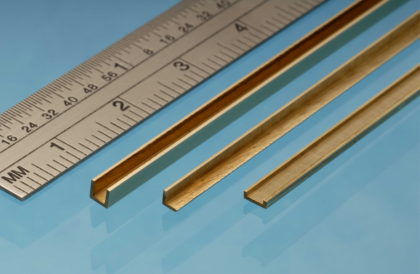
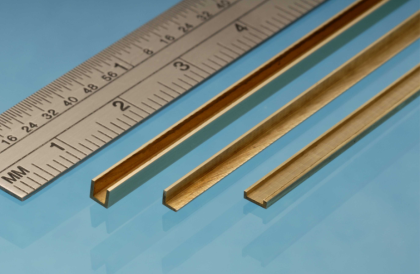
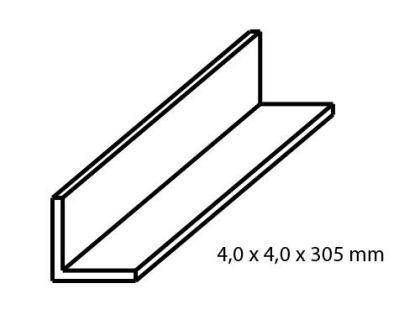
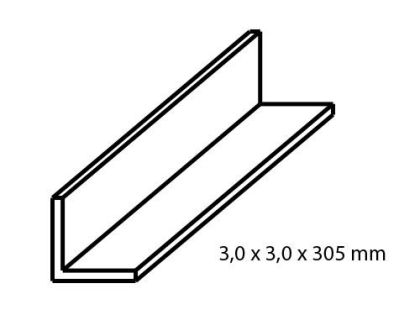
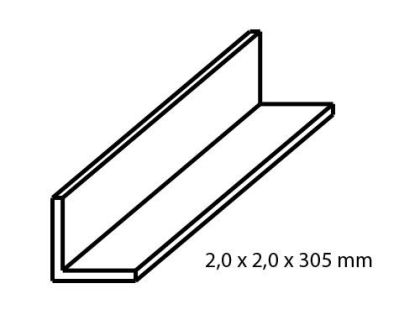
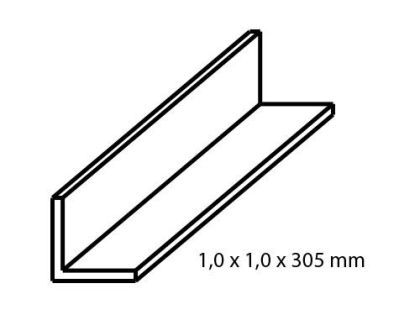
The brass L profile is an angle with two legs meeting at ninety degrees. Sizes run 1 × 1, 2 × 2, 3 × 3, 4 × 4, 5 × 5 and 6 × 6 mm, so you can step up a millimetre at a time as the build demands.
A brass angle has a markedly thinner wall than the styrene equivalent, it holds its right angle without help, and it can be soldered. That makes it the stock for frames, corner trims, load-bearing gratings and stiffeners wherever the structure has to look slender and still take weight.
Chiefly when a styrene section would be too coarse for the scale. A 2 mm angle with a thin wall reads in 1:48 as a section almost ten centimetres across the leg, yet the wall stays realistically fine. The plastic equivalent at the same leg length would have a wall several times too thick, and on a finished model that shows. The second reason is load: a brass frame will hold hanging parts without sagging.
Legs of 1 and 2 mm belong in small frames, hatch surrounds and interiors. Three to four millimetres build load-bearing gratings and superstructure frames. The 5 and 6 mm sizes make sense in large scales, on display bases and on scenic structures where the section carries the weight of the whole model. For the full survey of metal shapes, look through the brass profiles.
Brass is not sliced with a knife. Part thin pieces with nippers, thicker ones with a fine saw, then square the end with a file. Mitre both ends at forty-five degrees for corner joints so the frame keeps its dimension. Parting tools are listed under pliers and cutters.
Soldering gives the strongest result. On models that will not be stressed, cyanoacrylate or two-part epoxy on a keyed, degreased surface is enough. Brass always needs a primer before colour. If you need the same section in plastic because the joint will be solvent-bonded, use the styrene L profile instead.
Slender metal frames and gratings turn up constantly on ship superstructures, so the kits that use them are in ship model kits.