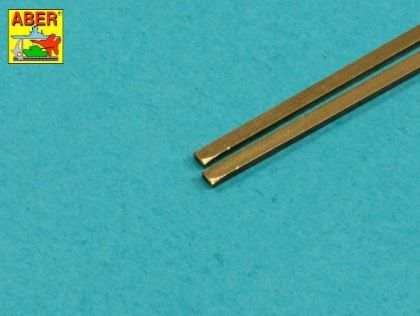
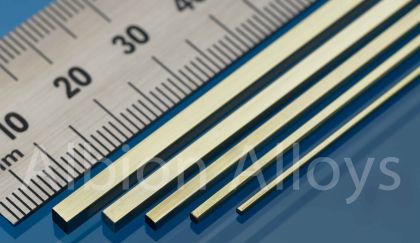
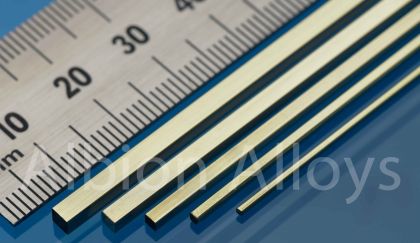
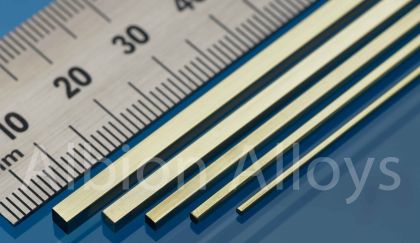
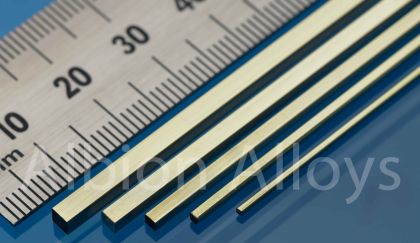
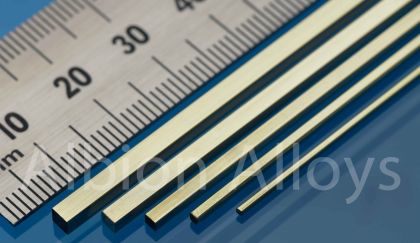
Brass square rod is solid stock with a rectangular or hexagonal section. The square sizes run from one millimetre to three, the hexagons come in 1 and 1.5 mm, and lengths are 245 and 305 mm. Solid brass does not deform, stays dead straight and can be soldered, so it becomes axles, pins, load-bearing struts and spigots.
The hexagonal section has a second use entirely: slice half a millimetre off the end and you have a finished bolt or nut head, with six flats that are perfectly even all the way round.
Two properties styrene cannot match: load capacity and straightness. A 2 mm section will hold a cantilevered superstructure or a hanging arm, and it will not sag after years on a shelf. It also stays straight along its whole length, so an axle made from it keeps both wheels in one line instead of letting them splay.
The commonest job. A length pushed into a drilled hole makes a pin that an excavator arm or a moving hatch can swing on. Because brass does not flex, the pivot has no slop and will not wear oval the way a styrene one does. For round sections, carry on to wire and rod.
A half-millimetre slice of 1.5 mm hex rod is a finished nut. In 1:35 that reads as a nut over five centimetres across — the sort found on chassis structures and towing gear. For finer bolt detail in smaller scales it is quicker to use ready-made parts from rivets, bolts and nuts.
A length glued inside a seam works as a spar on any model that will be carried about. Wings, undercarriage legs and long arms all benefit. The remaining metal shapes are grouped under brass profiles.
Rigid axles and pivots matter most on subjects with moving parts, so the kits that use them are in car model kits.