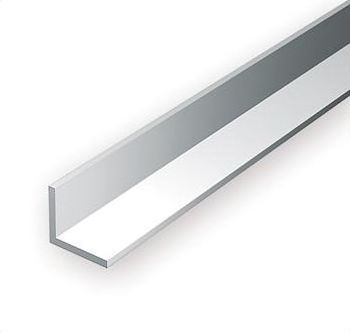
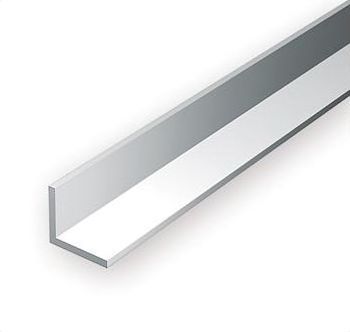
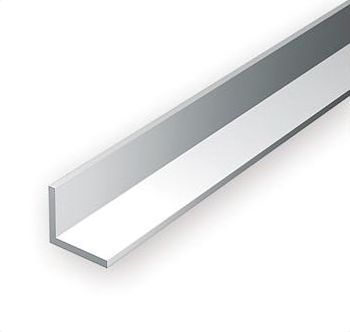
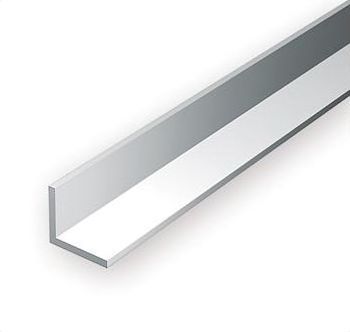
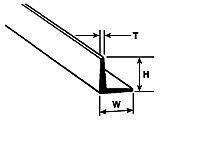
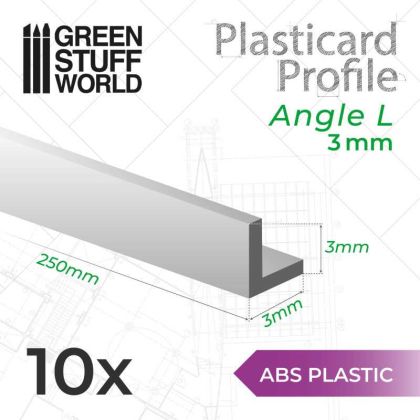
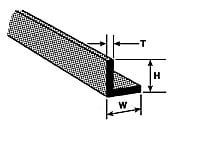
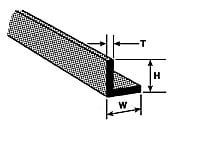
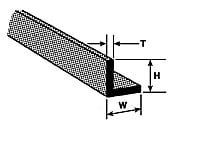
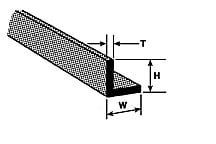
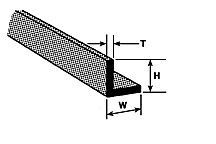
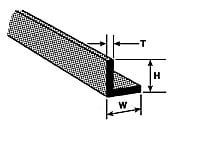
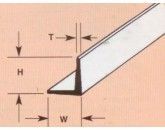
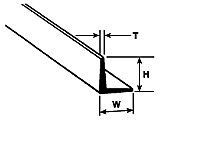
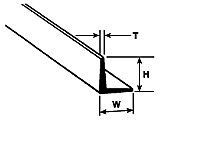
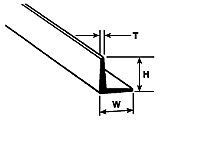
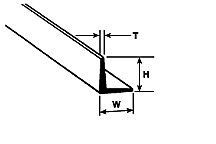
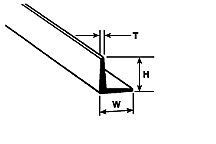
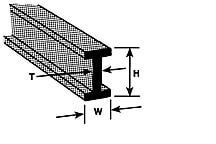
The L profile, or angle, is plastic stock with two legs meeting at ninety degrees. It copies the commonest rolled steel section of all, so it goes wherever the real structure stands on an angle: door and hatch frames, corner trims on superstructures, plate stiffeners, load-bearing gratings, jambs and the edges of a load bed.
Legs run from 1.2 mm to 9.5 mm, walls from 0.4 to 1.7 mm, and lengths from 250 mm up to 600, so a long edge needs no joint along it anywhere.
An angle has two advantages. It holds a right angle by itself, so glued along an edge it stiffens and straightens that edge immediately. And it copies the real rolled section that the frames, gratings and structures of actual machines and buildings are built from. Nothing has to be assembled from two strips, because the corner joint is already there and has no seam in it.
A leg up to two millimetres is a small trim or a hatch surround. Three to five millimetres builds load-bearing frames and gratings. The largest series around nine millimetres make sense in big scales, on display bases and on scenic structures. In 1:35 a 3 mm leg reads as an angle roughly ten centimetres across the face.
A thin 0.4 to 0.6 mm wall looks more convincing in small scales, because real sections are not drawn as solid bars. Walls from 1 mm up are for places where the section carries weight or will be handled after painting. If the wall has to be thinner than plastic allows at all, the brass metal L profile is the dependable answer.
The 600 mm lengths pay for themselves on long edges where a joint would show: hull sides, chassis rails, deck railings. For small work, shorter pieces mean less waste. For structures with two flanges, carry on to the U channel.
Frames and gratings built from angle turn up on practically every kind of subject, so the full survey of kits is in the plastic model kits.