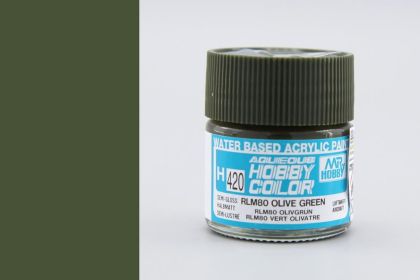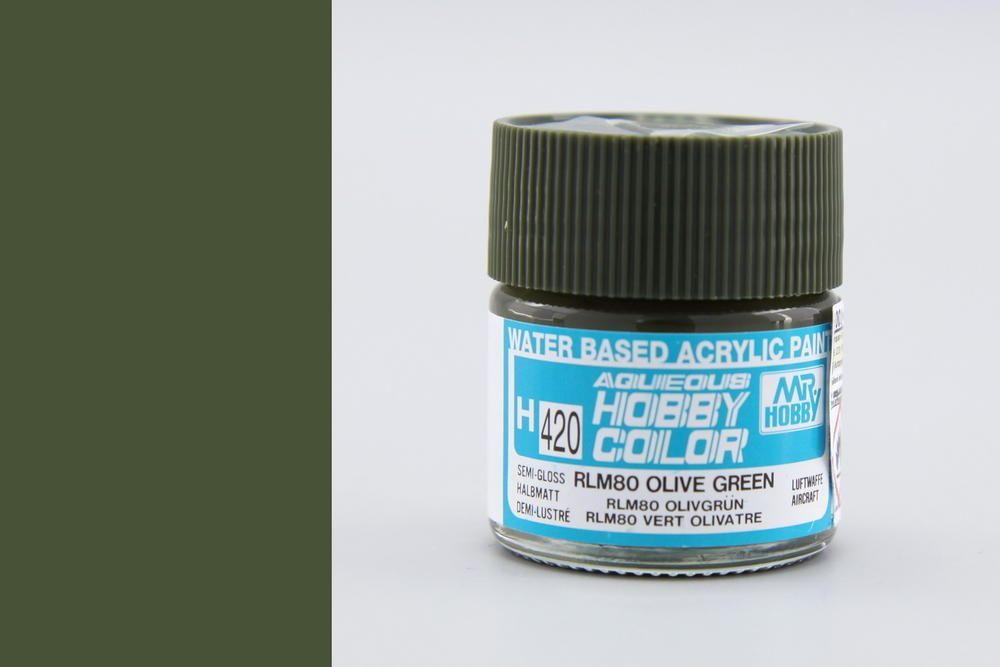

The olive green tone of the late German camouflage RLM 80. A water-based acrylic paint, ten milliliters.
Responsibility details are not available.
The designation RLM 80 belongs to an olive-toned green introduced in the last years of the war. You will most often see it as irregular mottling on the sides of the fuselage and on the fins of late-version Messerschmitt Bf 109 fighters, as well as on Focke-Wulf machines and on some ground-attack aircraft, where it formed part of the move toward the darker and less conspicuous schemes of the end of the war.
Ten milliliters of modeling acrylic paint whose carrier is water. The range was created for spraying, but it does not rule the brush out. It is enough to mix in about a quarter share of retarder so that the bristle marks have time to flow together before the surface skins over.
Anyone painting mottled camouflage for the first time will appreciate a test on a piece of scrap plastic. The right degree of thinning is hard to find. Thick paint creates a sharp edge that does not belong to a mottle, while thin paint runs under the shield and bleeds into an area that was meant to stay clean. Between the two extremes lies a narrow band in which the mottle keeps a soft transition.
You can liven up a continuous area of this tone by mixing a drop of a lighter green into the paint and lightening the middle of the larger panels. The resulting difference should be barely perceptible; strong contrast looks unnatural on a model and draws attention away from the shape of the airframe.
Naši poradci a znalci sortimentu jsou připraveni odpovídat na Vaše dotazy (Po–Pá, 8–18 hod).
Zeptejte se na co potřebujete, odpovíme co nejdříve.
Texts from customers in the advice section reflect solely the opinions and views of the customers. MNF trade s.r.o. does not approve or verify customer texts in advance.
There are no questions here yet. Be the first to ask!