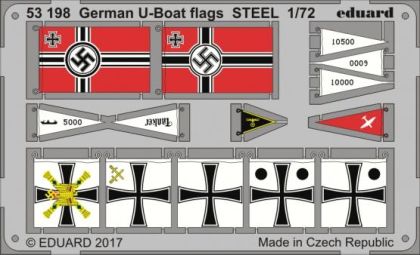
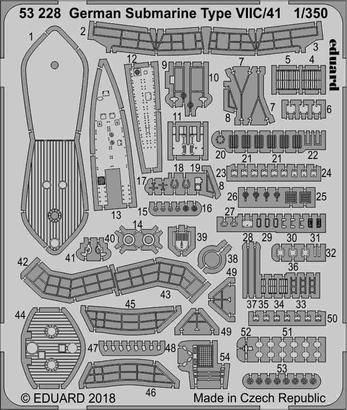
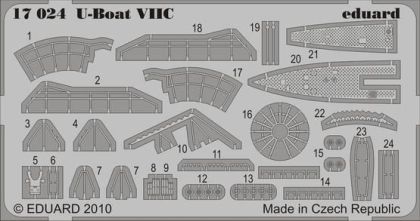
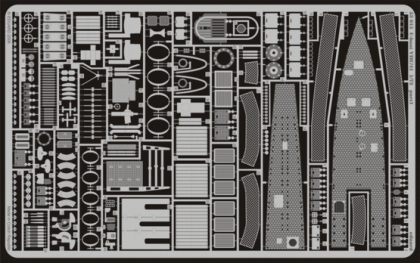
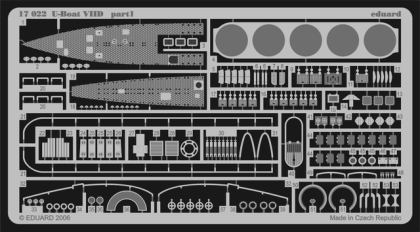
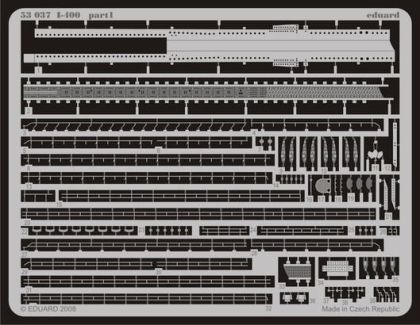
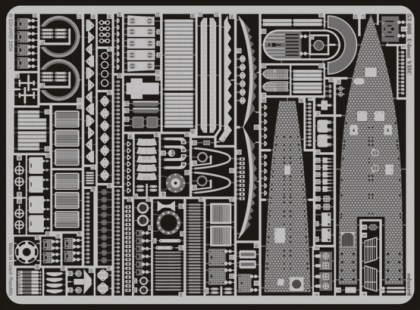
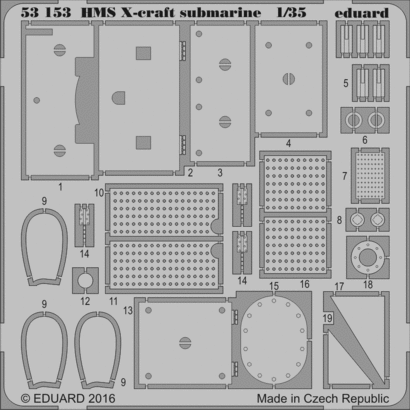
Photo-etched parts are thin brass or steel sheets with the detail chemically etched through them. On a submarine they earn their place in one specific way: the casing of a real boat is pierced with free-flood slots and covered in gratings that are a fraction of a millimetre thick, and no injection mould can produce that. Replace the solid plastic deck panels with etch and the boat stops looking like a toy tube.
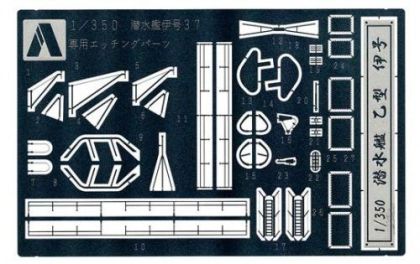
The frets here run from single flag sheets and railing runs to complete detail-up sets for one named boat, with periscope shears, net cutters and antenna rigging on the same sheet. Below: how to work brass without creasing it, and when etch is the wrong material for the job.
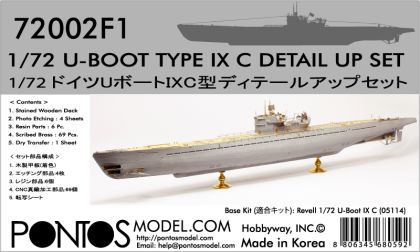
Coverage concentrates on Second World War U-boats — Type VIIC, VIIC/41, VIID and Type IX — plus midget craft and a handful of Japanese and Allied boats. Depending on the set you get casing gratings and free-flood slot overlays, deck railings and stanchions, periscope shears, net cutters, radio and radar aerials, sheet-metal flags pre-printed or in steel for folding, and small fittings such as hatch wheels and ladders. Sets labelled as detail-up usually combine all of these for one kit; single-purpose sheets do one job and cost you far less bench time.
Brass straight off the fret is springy and will crack along a fold. Pass it briefly through a flame until the colour shifts, let it cool, and it becomes soft enough to follow the curve of a casing by hand. Steel frets — flags especially — are meant to hold a shape and should not be annealed.
Part the attachment tabs with a scalpel against a hard surface rather than twisting the part free; a twisted tab leaves a bulge you will never sand flat on a railing. Clean up the stub with a file or a fine sanding stick before the part goes near the model.
Brass needs cyanoacrylate or epoxy — polystyrene cement does nothing on metal, so keep the right adhesives to hand. Prime the fret before you remove the parts: a thin coat of primer on both faces while they are still attached is far easier than chasing bare metal edges afterwards.
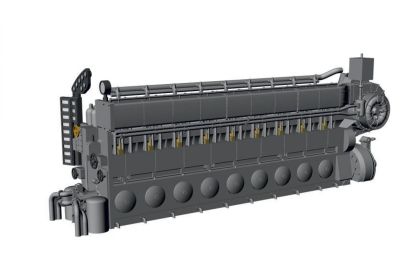
Anything that has to be truly round — a gun barrel, a periscope tube, a torpedo body — is better in turned brass than rolled from flat etch. Volume parts such as engines and bunks belong in resin; see submarine accessories for those.
Boats in every scale are listed under submarine model kits.