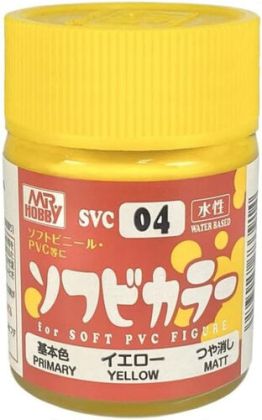
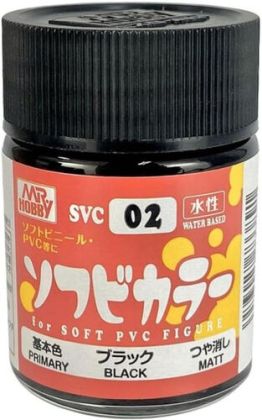
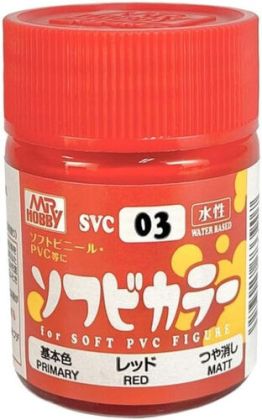
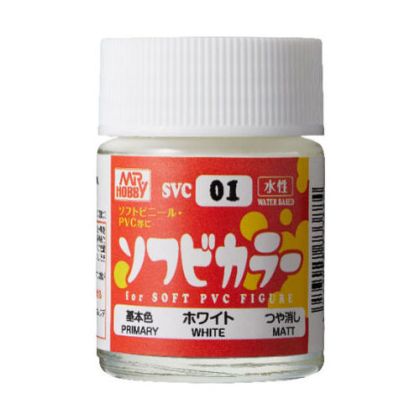
The SVC series is the part of the Mr.Color range developed for figures made of soft PVC. A material like that bends and compresses, so an ordinary finish on it cracks or peels in time. This series is built with that in mind.
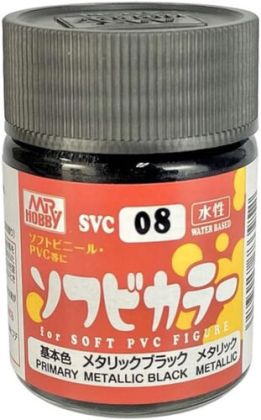
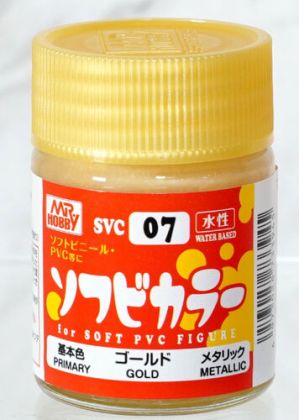
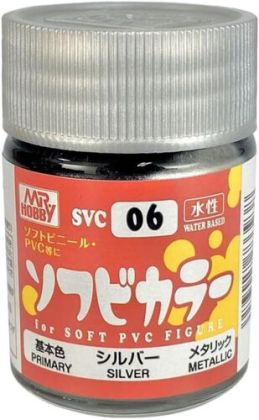
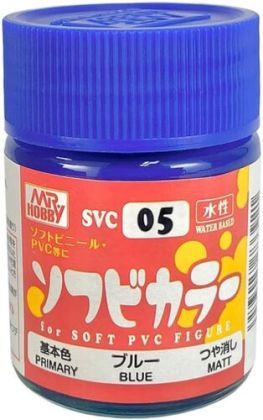
It holds matt white, black, red, yellow and blue as the opaque palette, with metallic gold, silver and black alongside. How to prepare the surface and what to avoid when working with a flexible material follows below. The paragraphs below cover degreasing, coat thickness and the handling that decides whether the finish survives.
Plasticised vinyl contains softeners that migrate to the surface over time. On such a ground, ordinary paint either fails to grip or stays permanently tacky. Mechanical stress adds to that: a soft figure is handled, squeezed and bent, and a rigid finish will not survive it. Paints formulated for this material are therefore made to key onto the surface while keeping a degree of flexibility.
The palette is deliberately economical, because soft figures tend to have simple colour schemes and elaborate modelling will not stay on them anyway. Intermediate tones can be mixed on the palette from the five opaques, so the range is less limited than it first appears.
A new soft PVC part arrives greasy from production, and softeners reach the surface during storage as well. Wash it in lukewarm water with a degreasing agent, rinse and let it dry completely. Suitable products are in the modelling chemicals category.
A heavy coat is the worst thing you can do on a flexible ground, because it is the first thing to crack. Lay several light passes and let the paint dry fully between them. Leave the finished figure untouched for at least a day before handling it.
Metallic gold, silver and black rub off easily on a soft surface. Keep them to areas you do not touch when handling the figure, and compare the options in the metallic model paints category.
The brand's other shades for hard plastic are in the Gunze Mr.Color category.