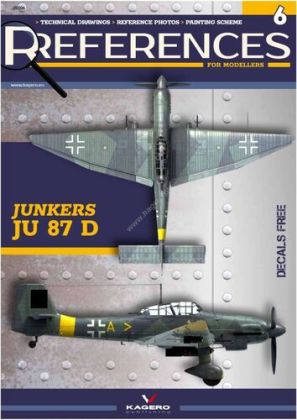
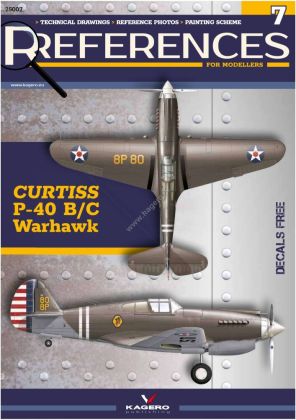
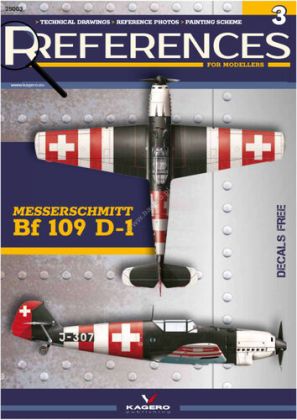
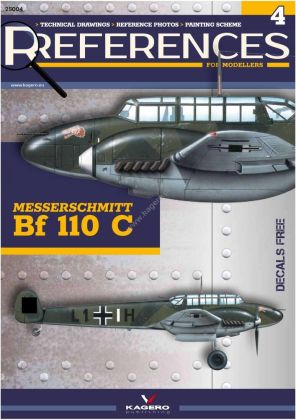
References is the Kagero line in which photographic and profile documentation of a single type carries the book, with a decal sheet included. In the titles listed here the decals are supplied in 1:72 and 1:48, so one volume serves the two most widely built aircraft scales at once. The subjects covered are the Curtiss P-40 B/C Warhawk, the Junkers Ju 87 D, the Messerschmitt Bf 110 C and the Messerschmitt Bf 109 D-1 - all four mainstream types with plenty of kits behind them, which makes the books useful for detailing as much as for markings. Below we explain what transfers from the page to the model.
The balance is reversed compared with a text monograph: archive images, close-up views and colour profiles dominate, while the text supports them. For a builder that means the book earns its keep in two phases - while adding detail, comparing photographs against parts, and while painting, working from the profiles and the enclosed sheet.
Photographs usually reveal what a kit simplifies: cable runs in the wheel bays, the shape of exhaust shrouds, aerial attachments, the difference between an early and a late canopy. You do not have to add everything - pick two or three features that will be visible on the finished model.
A double sheet helps if you build the same type in two sizes, or if you have not yet decided on a scale. There is a practical difference between them: in 1:72 the markings are smaller and less forgiving of an uneven surface, while in 1:48 they settle more easily and cope with more relief.
To make a book sheet look as though it were painted on, the surface underneath has to be gloss and genuinely smooth, and the decal needs a setting solution to pull it down. A matt or semi-matt coat afterwards ties the markings to the paint.
For development history and variants in text form see Kagero aircraft books, for measurable drawings Topdrawings scale plans, and for the publisher as a whole Kagero books.