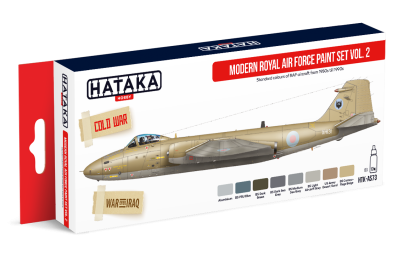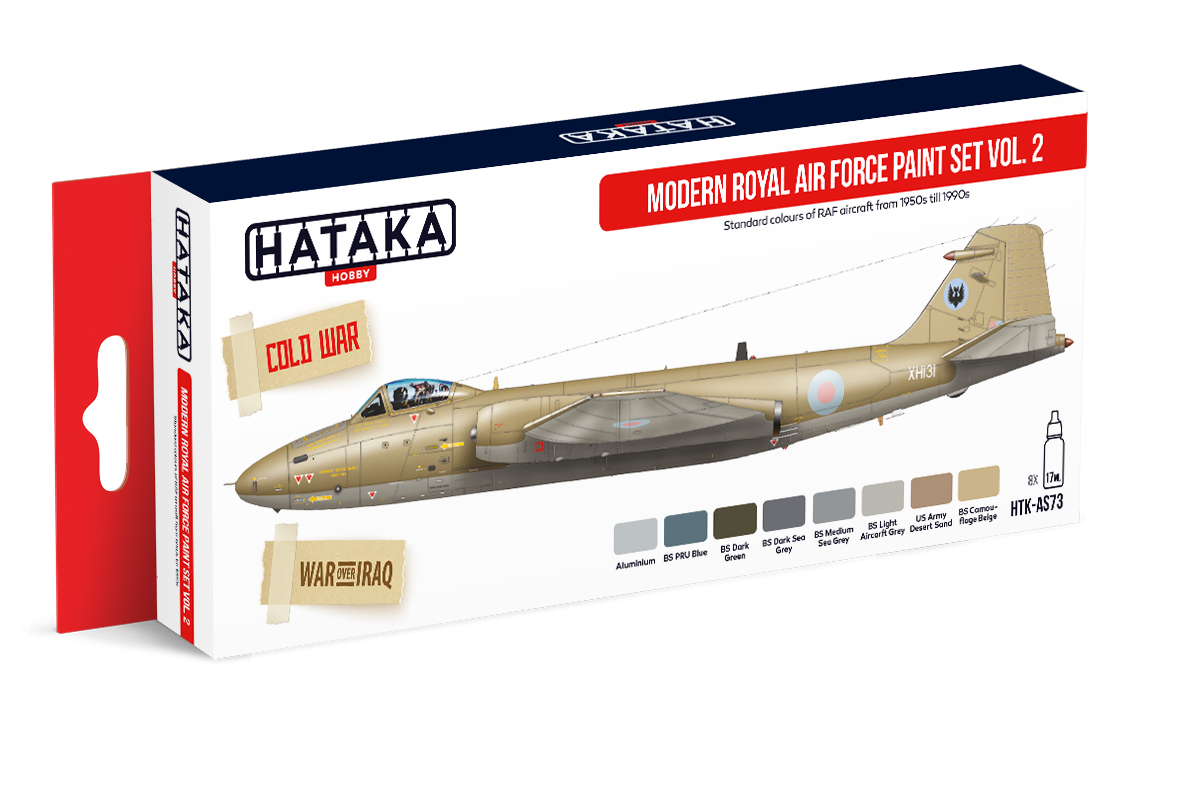
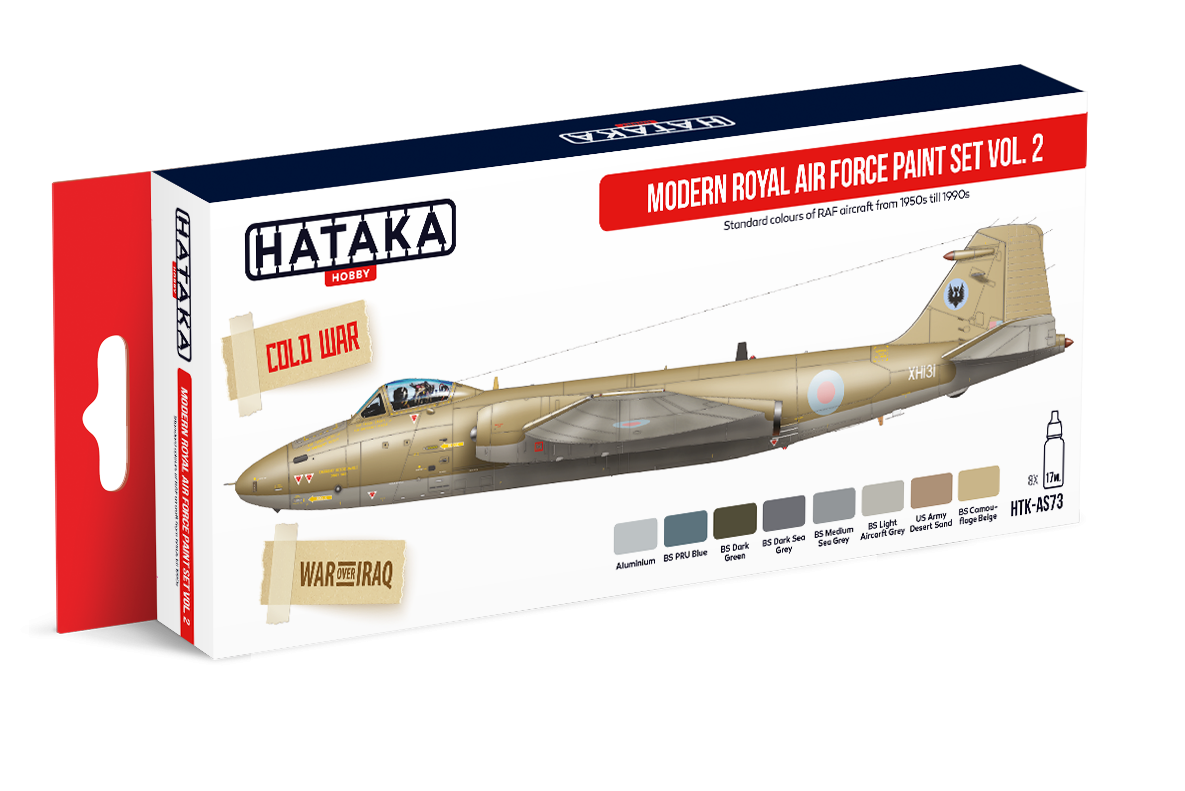
Eight shades of the combat aircraft of the Royal Air Force: the postwar silver, the classic British camouflage, the desert finish of 1991 and the hemp gray.
Responsibility details are not available.
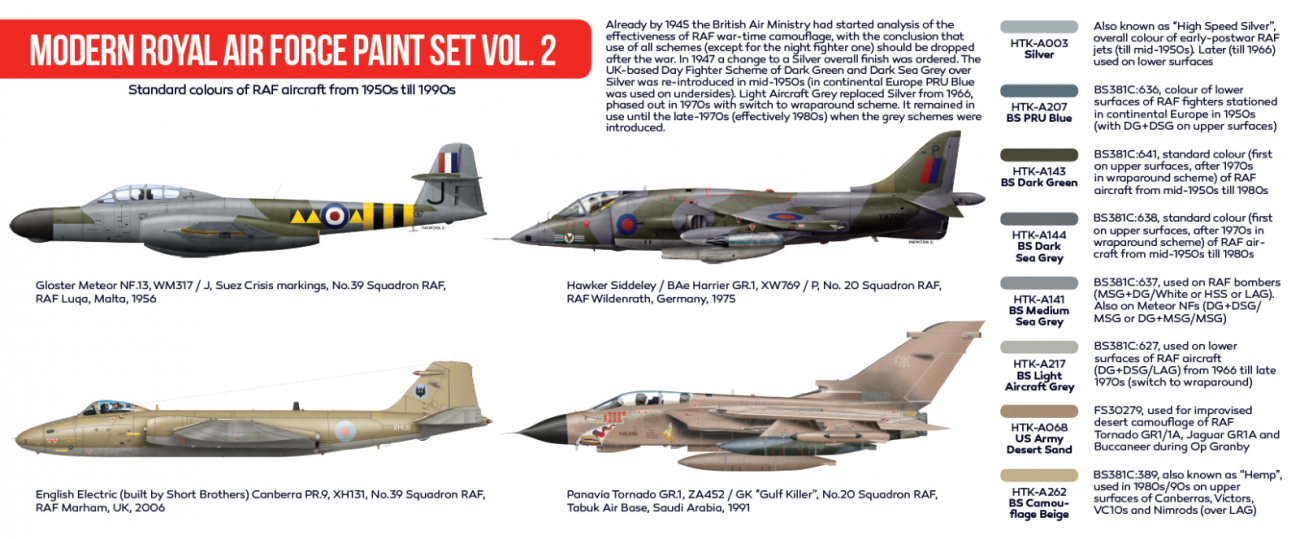
The second volume of the British range follows combat aircraft, not trainers. It begins in the middle of the fifties, when the jet aircraft of the Royal Air Force flew all-silver, and goes on with the blue-gray shade 636, with which the lower surfaces of fighters stationed in continental Europe were painted.
The core of the set is made up of the pair of the dark green 641 and the dark sea gray 638. At first they covered only the upper surfaces, after the seventies they carried over to the underside in a wraparound form and in that guise they stayed until the eighties. The medium sea gray 637 belongs to bombers and to the night versions of the Meteor, and the light aircraft gray 627 to the lower surfaces in the period between 1966 and the end of the seventies.
The last two bottles cover the detours. The desert sand shade FS 30279 was carried by the improvised finishes of the Tornado, Jaguar and Buccaneer machines during the operation in the Persian Gulf in 1991. The hemp beige 389 appeared from the eighties on the upper surfaces of large aircraft, namely on the Canberra, Victor, VC10 and the patrol Nimrod types, and it is a shade that is hard to mix up from an ordinary palette.
Naši poradci a znalci sortimentu jsou připraveni odpovídat na Vaše dotazy (Po–Pá, 8–18 hod).
Zeptejte se na co potřebujete, odpovíme co nejdříve.
Texts from customers in the advice section reflect solely the opinions and views of the customers. MNF trade s.r.o. does not approve or verify customer texts in advance.
There are no questions here yet. Be the first to ask!