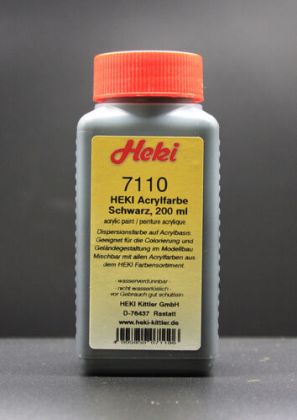
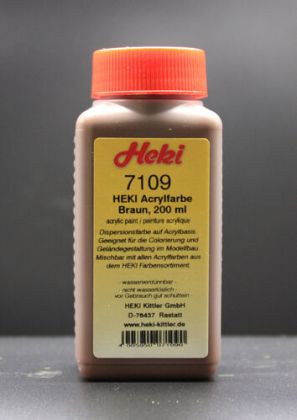
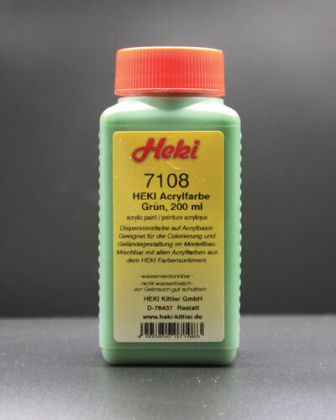
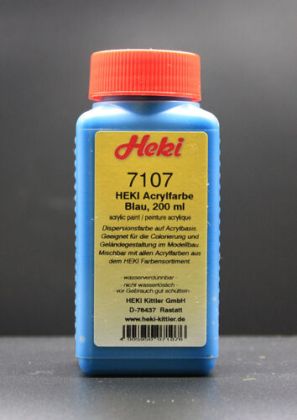
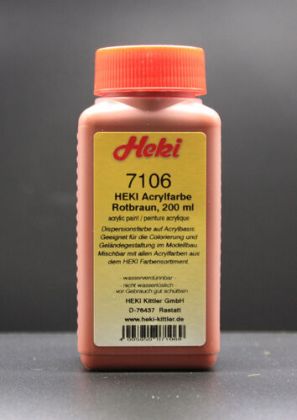
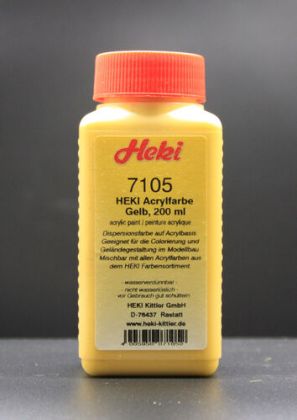
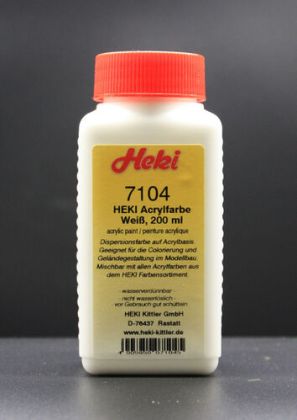
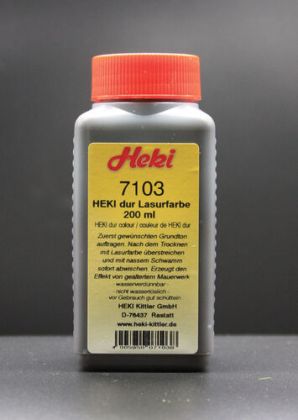
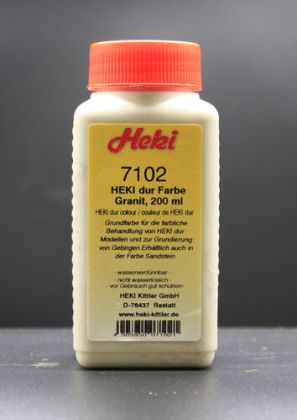
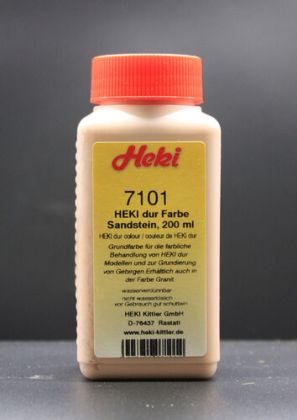
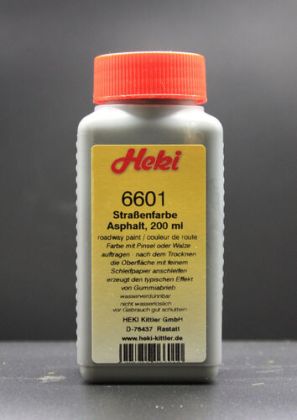
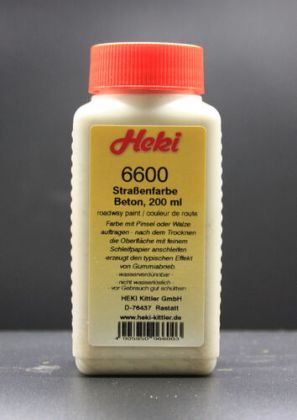
Heki paints are aimed at layouts and scenery rather than at the models standing on them. The range is acrylic: a basic palette of black, brown, green, blue, yellow, white and chestnut, plus rock colours in granite and sandstone, a transparent version for lightening a tone, and roadway paints in asphalt and concrete grey. They are made for large areas, applied with a sponge or a wide brush rather than drop by drop, and used in quantities no plastic kit would ever need.
On a model the aim is precision; on terrain it is the impression of the whole. The method follows from that: paint goes on generously and unevenly, often with a sponge, a rag or an old brush, and the goal is irregularity rather than a smooth film. The rock colours are built for it, because brushed onto a coarse surface they run into the cracks and stay lighter on the raised areas, so the relief appears by itself. Roadway paints do the opposite job on a flat surface, where an even coat comes first and wear is suggested afterwards. The transparent version exists so a shade can be lightened or softened without white being mixed into it.
On rock and earth, start with the darkest tone over the whole area and then drag lighter colours across the raised parts only. Reversing the order drives dark paint into places it should not reach, and the lighter areas are then hard to recover.
Neither asphalt nor concrete is ever uniform. After the base coat, suggest wheel tracks, oil staining down the centre of the lane and lighter worn edges at the verge, with materials from weathering products and weathering pigments.
Terrain uses many times more paint than a model. Estimate the area before you start and mix one large batch rather than topping up in small amounts, so a joint between two mixes never shows across a rock face.
Other water-thinnable ranges, including shades for the models themselves, are in the parent category acrylic model paints.