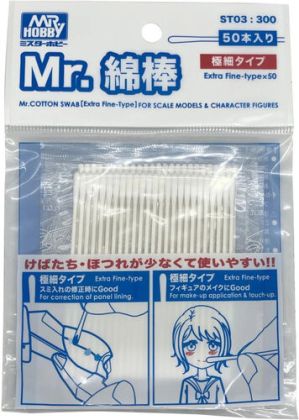
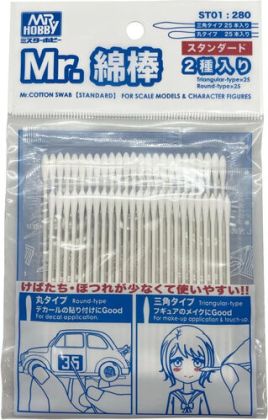
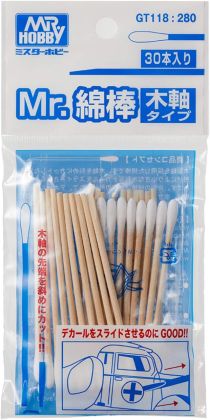
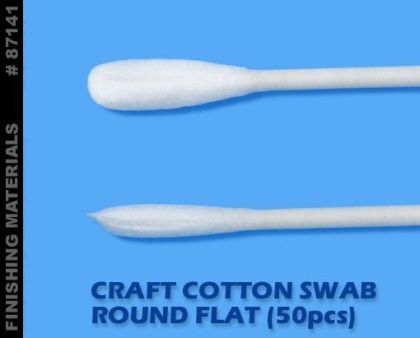
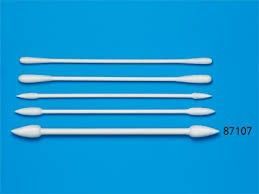
Modelling cotton swabs look like a pharmacy item but do a different job. The head is wound firmly so it does not fluff up or shed fibres into fresh varnish, and it comes in several profiles — round, flat, and triangular with a point that reaches into a corner. They are used for wiping back surplus wash, blending pigments into a surface, lifting paint locally with thinner and cleaning a model before it is sprayed. Keeping two profiles on the bench covers almost everything, and because they are consumable there is no reason to re-use a dirty one.
 Tamiya Craft Cotton Swab (50 pcs.) - Čistící štětečky
3.16 €
Tamiya Craft Cotton Swab (50 pcs.) - Čistící štětečky
3.16 €
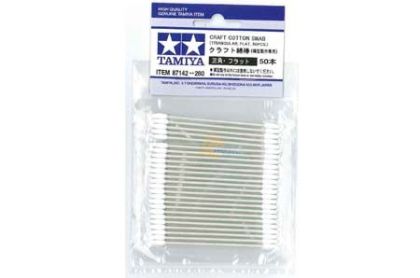 Tamiya Craft Cotton Swab (Triangular, Flat) (50 pcs)
3.16 €
Tamiya Craft Cotton Swab (Triangular, Flat) (50 pcs)
3.16 €
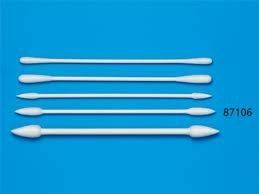 Tamiya Craft Cotton Swab (50 pcs.) - Čistící štětečky
3.16 €
Tamiya Craft Cotton Swab (50 pcs.) - Čistící štětečky
3.16 €
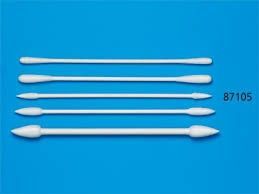 Tamiya Craft Cotton Swab (50 pcs.) - Čistící štětečky
3.16 €
Tamiya Craft Cotton Swab (50 pcs.) - Čistící štětečky
3.16 €
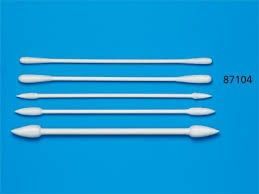 Tamiya Craft Cotton Swab (50 pcs.) - Čistící štětečky
3.16 €
Tamiya Craft Cotton Swab (50 pcs.) - Čistící štětečky
3.16 €
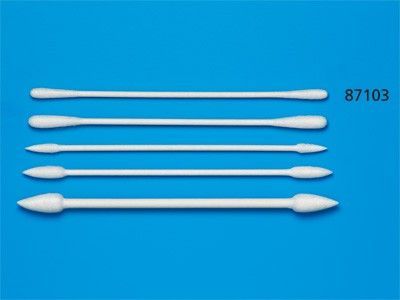 Tamiya Craft Cotton Swab (50 pcs.) - Čistící štětečky
3.16 €
Tamiya Craft Cotton Swab (50 pcs.) - Čistící štětečky
3.16 €
Two reasons. Their cotton sheds fibres that stay in matt varnish or in a wet wash, and once there they cannot be removed without refinishing. And they come in one shape only — a round head that will never reach a sharp corner. Modelling swabs answer both: the head is reinforced and the profiles can be matched to the spot.
The classic job. A wash is flooded over a panel, settles into the grooves, and the surplus is drawn off with a swab dampened in thinner, following the airflow of the subject. Flat and triangular heads keep the stroke in one plane and will not scrub the colour out of the groove. The materials themselves are in weathering.
Dry pigment is rubbed into the surface with a swab and pressed into relief. Against a brush it carries no static charge and does not act like a broom, so the layer stays fine. It follows on from pigments.
A swab dampened in thinner lifts paint off a small area without respraying a whole part. It also serves before spraying — a surface free of grease and dust holds paint considerably better.
Liquid filler and surplus solvent cement can be wiped away while still wet, which is faster than sanding later and leaves the detail around it untouched. A swab is also what presses masking tape down into an edge so paint cannot creep under it, and that is the difference between a crisp demarcation and a blurred one.
The head is absorbent, so it will happily take up more liquid than you intended. Dip only the tip, wipe the excess off and change swabs often. And be careful with fresh paint: until the surface is properly cured, a swab will burnish it or pick it up even under a light touch.
With the surface clean and free of dust you can move on to varnishes, which close the work off.