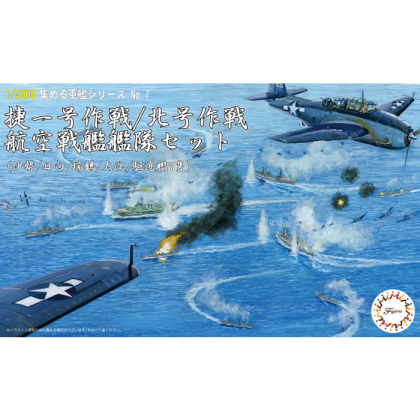
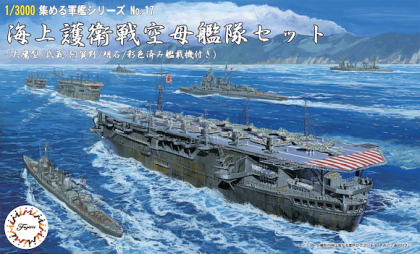
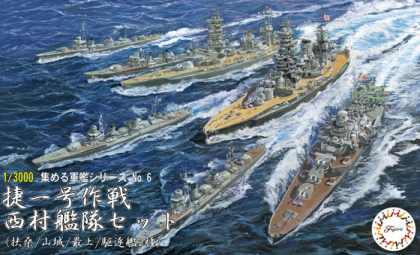
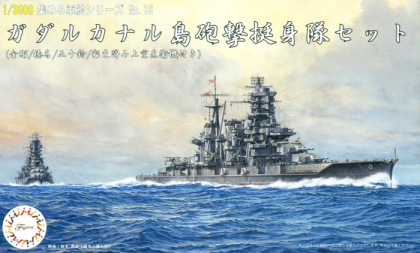
Instead of one ship you get a whole operational formation: 1:3000 ship model kits are sold as sets that reconstruct genuine Imperial Japanese Navy groupings, from the fighting around Guadalcanal to the late-war Pacific. One box holds battleships, carriers and escorts as waterline hulls, ready to be arranged on a board that stands in for the sea. A battleship measures around nine centimetres here, yet the superstructure relief stays surprisingly crisp. Below you will find how to display the sets and how to keep such small parts under control.
This is the smallest ship scale in the catalogue and it is built around history rather than individual vessels. Each set matches a real formation and a real period, so the hulls you put together actually sailed in company. Waterline bottoms sit flat on the board, which means no stands and no fiddling with brass rod.
Pick the period that interests you: the sets cover the famous groups from the Guadalcanal campaign as well as escort and convoy formations from the closing phase of the Pacific war. Each product description lists the vessels in the box.
The sets are designed to sit together and can be built up into larger scenes. A board painted deep blue with a little texture turns a shelf into a stretch of ocean. The same idea with present-day fleets is covered by 1:2000 ship model kits, while individual hulls with more detail per ship are the province of 1:1200 ship model kits.
A trace of thin cement and a pair of tweezers is the whole technique. Hold hulls by the hull, never by the superstructure, and cut small parts from the sprue only at the moment you need them. Painting is simplified by the uniform grey of the Japanese ships: a base tone, a darker wash in the recesses and drybrushed edges turn centimetre-long silhouettes into recognisable warships.
For an overview of every scale and vessel type, start at ship model kits.