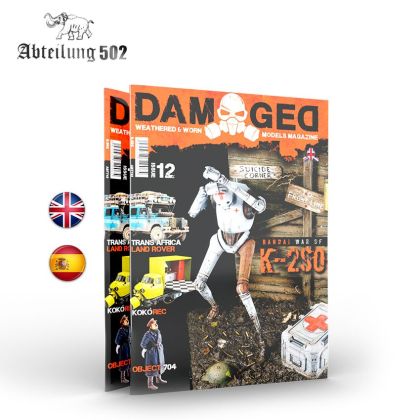
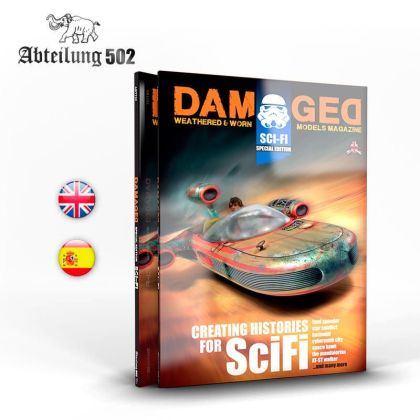
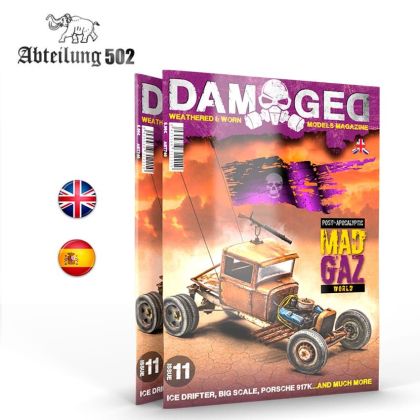
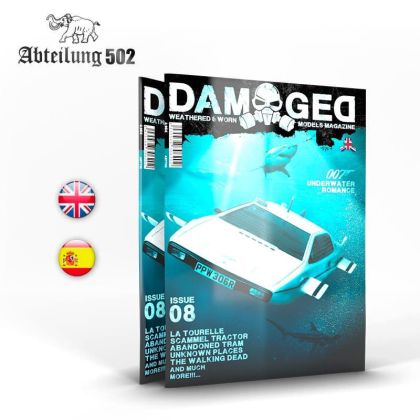
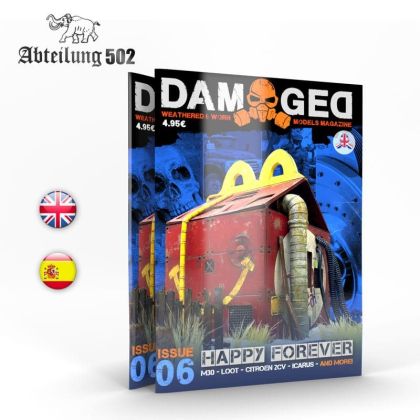
Rust, flaking paint, overgrown wrecks, derelict buildings, industrial scenes and objects left lying for twenty years - Damaged Magazine covers one subject and covers it thoroughly. It is not a conventional modelling title with kit reviews; it is a picture-led, method-led series in which surface structure replaces variant tables. Alongside the numbered run there is a standalone volume devoted to science fiction subjects. Below we explain who gets the most out of it.
Wear can be applied fast, and it usually looks wrong when it is. Real decay has order: rust forms where water stands and where the coating has failed, paint chips along edges and wherever a boot or a tool makes contact, moss grows on shaded sides and in corners. A publication that puts photographs of genuine derelict objects next to the bench process teaches the logic rather than a single trick.
Pick one photograph from an issue and keep it beside the model as the target. Without a specific reference, weathering drifts into everything-everywhere and the result reads as merely dirty rather than derelict. One reference and two or three effects beat ten layers applied hopefully.
Three tools recur across the series: textured pastes for lifted paint and rough surfaces, rust and texture tones built up in thin layers, and staining that runs downwards. That last point decides whether rust convinces, because streaks must have a direction.
A derelict subject almost always needs a setting. A wreck on a clean base does not work; add ground, overgrowth or a fragment of wall and everything falls into place, which is why many articles move from model to diorama.
For step-by-step instruction in book form rather than magazine form, see modelling technique books.