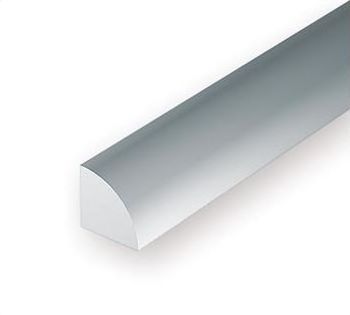
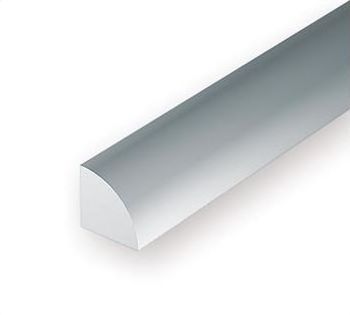
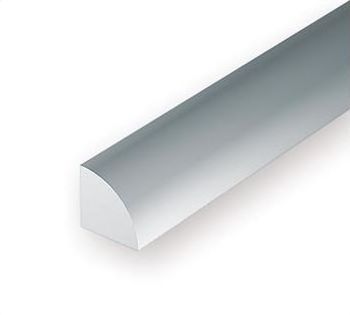
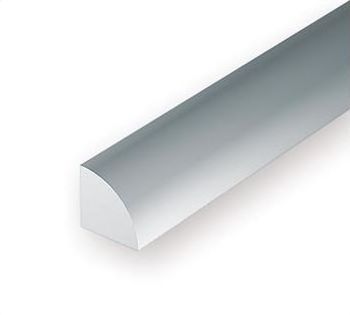
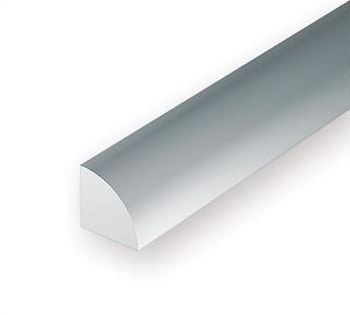
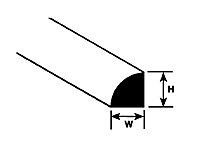
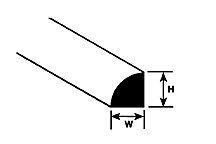
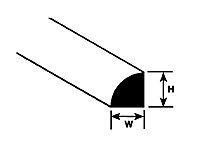
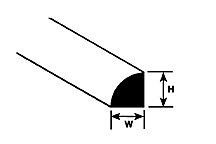
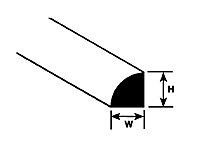
Quarter-round is a profile whose section is a quarter of a circle: two flat faces meeting at a right angle with an arc between them. That is why it belongs in corners. Glued into a corner it fills the gap, creates the transition radius a welded or pressed structure really has, and stiffens the joint from inside at the same time.
Sizes start at 0.75 mm and run to 3.2 mm, in a standard 250 mm length. Against filling a corner with putty, the profile is faster and the resulting line is identical along its whole length.
Real structures rarely have sharp internal corners. A weld, a pressing or a casting always runs out in a gentle arc, and that arc is what quarter-round imitates. On a model you will therefore find it where a wall meets a floor, at wing-root fairings, under superstructures, in the corners of cab interiors, and anywhere a visible seam needs covering without putty.
The finest series under one millimetre is enough for subtle transitions in interiors and in smaller scales. Two and three millimetre pieces create a pronounced fairing that reads at a glance and suits large scales and scenes. Always compare the radius with the surrounding detail: too large an arc simplifies the model visually.
The second role of quarter-round is hidden. Glued into the inside corner of two bonded surfaces it works as a corner fillet, so the joint survives later handling. If what you need is diagonal bracing instead, the triangular profile follows on from this one.
Laying in a profile is usually cleaner than filling the corner. Putty is awkward to sand in a narrow corner and the line often crumbles out of it. If you do fill the gap after all, the fillers are next door. For raised mouldings on an outside face, use the half-round profile.
Corner transitions are used heavily when building interiors and buildings, for which the diorama accessories follow on.