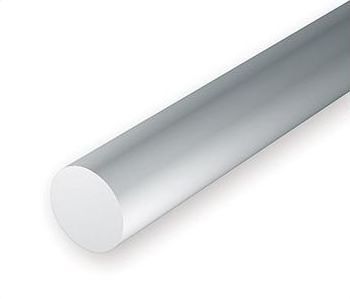
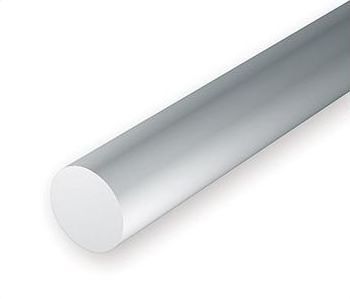
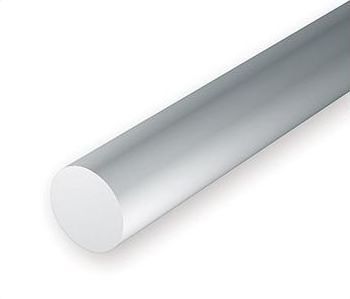
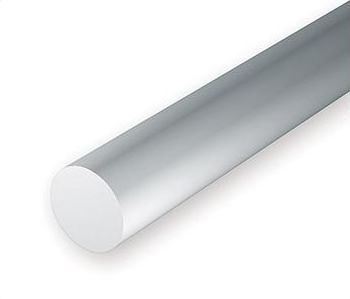
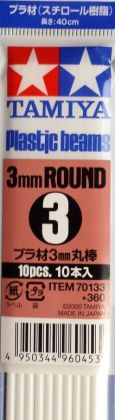
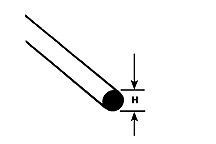
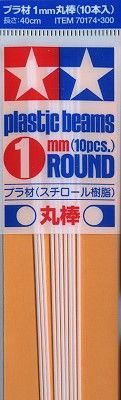
Styrene round rod is solid stock with a circular section. The finest pieces measure 0.64 mm and look like heavy monofilament; the thickest run to six and a half millimetres. Lengths are usually 250 and 350 mm.
On a model it becomes posts and stanchions, axles and pins, railings, aerials, grab handles, hydraulic rams, and even simple rivets if you push a short offcut into a drilled hole and sand the stub into a dome. Being solid, it also takes a point without collapsing.
It is the simplest section of all, and the one that covers the most ground. Solid material means the rod will not crack when flexed cold, it can be sanded to a point, and the cut face is a clean circle. Where it falls short is anywhere an opening has to be visible; that calls for styrene tube instead.
Series under one millimetre belong in 1:48 and smaller, as railings, aerials and plumbing. One to two millimetres reads in 1:35 as a tube about five centimetres across, the size of a typical grab handle or stanchion. Above three millimetres you are into pillars, wheel axles and shafts, so really into large scales from 1:24 upwards.
If the rod is to act as a pivot, pick a diameter one size under the drilled hole and take up the clearance with paint; the part can then still be adjusted before it is fixed. Static posts want the opposite, a tight fit, so the piece stands by itself and needs no propping while the cement sets.
For anything shaped into complex curves or carrying load, such as linkages, plumbing and suspension cables, copper or brass wire is more dependable. Plastic whitens after repeated bending and can snap; metal holds the shape with no spring-back at all.
While the cement sets it helps to support the model so the posts cannot splay, which is what the stands and clips are for.