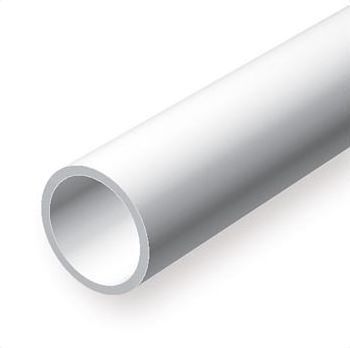
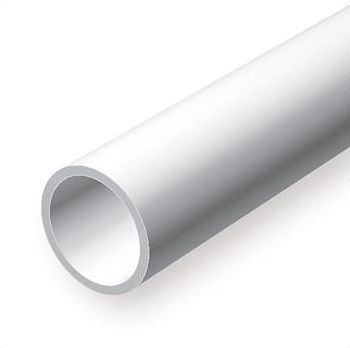
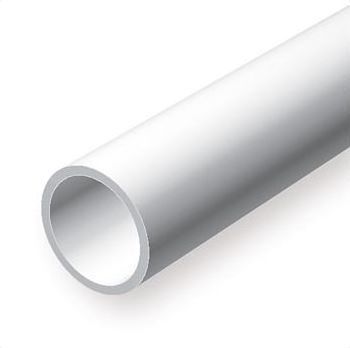
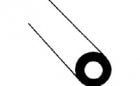
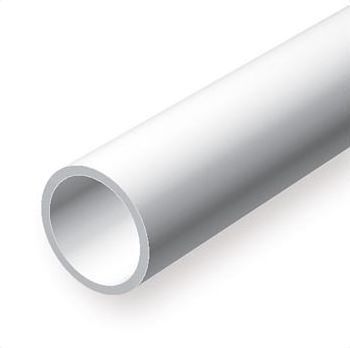
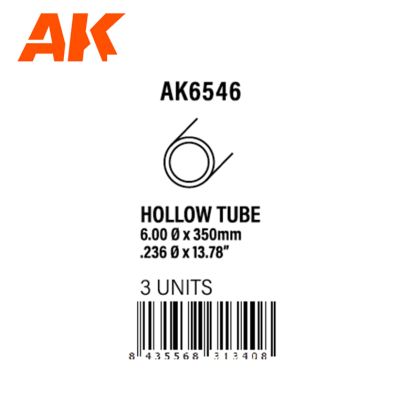
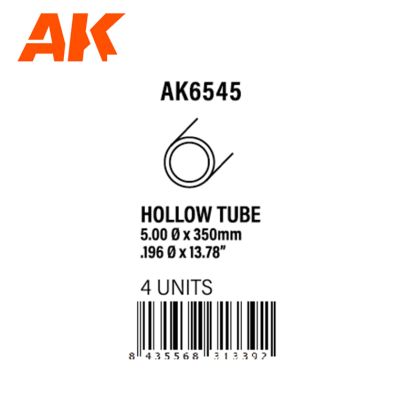
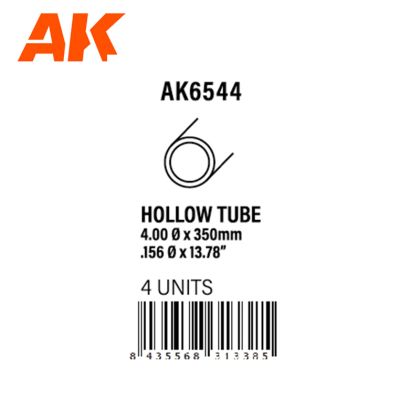
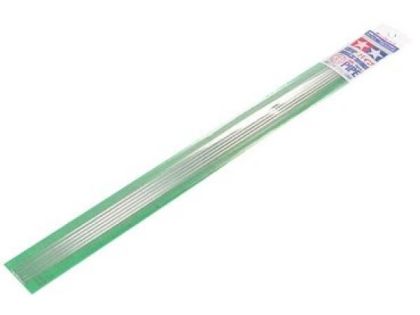
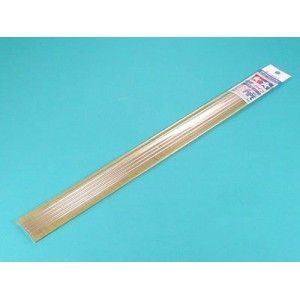
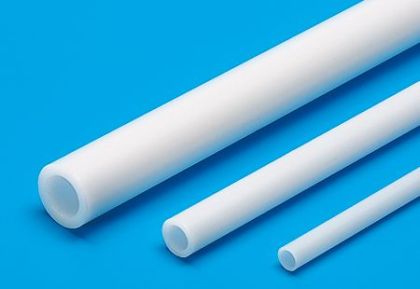
Styrene tube is hollow round stock, and on a model it covers everything that has to be a pipe: an exhaust, a barrel, a mast, a conduit, a sleeve or a cable duct. Diameters run from two millimetres to eleven, with walls most often 0.5 to 0.8 mm, in 350 and 375 mm lengths.
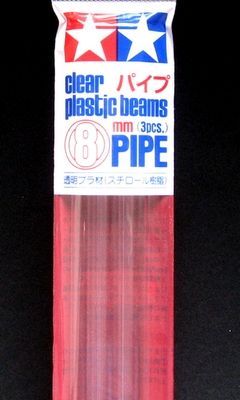
Beside the white and grey versions there is clear tube, where the transparency itself is the point, and plastic-coated butyrate rod for runs that need to be bent and then stay bent.
The open end is the main reason. An exhaust made from solid rod always reads as a cocktail stick, whereas a tube has a finished mouth as soon as it is cut and only needs the rim thinning from inside. The second advantage is assembly: a thinner tube pushed inside a thicker one holds itself, letting you build a telescopic mast or a joint you can still rotate before committing to glue.
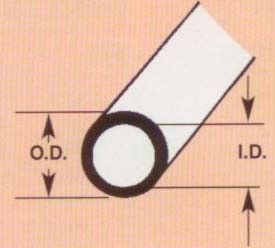
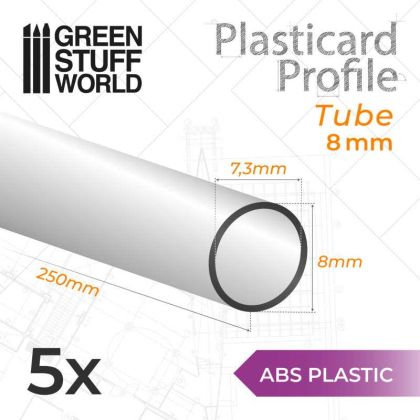
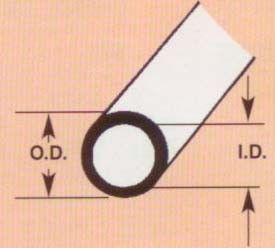
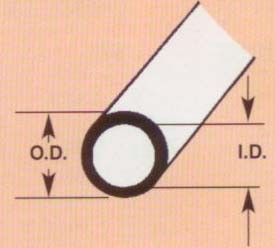
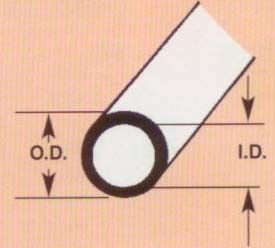
Tube is always quoted twice, outside diameter and inside diameter, or else wall thickness. If you want sections to nest, look for a combination where the outside diameter of the smaller piece is close to the inside diameter of the larger. Where the sizes do not match exactly, a length of wire or rod bonded inside works as a bushing.
For barrels and short exhausts, metal is usually better, because the wall is thinner and the mouth sharper; those are in the brass tube. Plastic wins on long runs, masts and pipework, where it bonds to a plastic surface and sands flush with the part. For square ducting and framing, use the square tube instead.
Never bond clear profiles with solvent anywhere they will be seen, because it fogs them. They are used as light guides, lens surrounds and ducting for lighting. Smooth the cut end with the finest abrasive and polish it; the transparency comes straight back.
Tube is bought most often by builders of vehicles and armour, for exhausts and pipework, so the kits behind them are in military model kits.