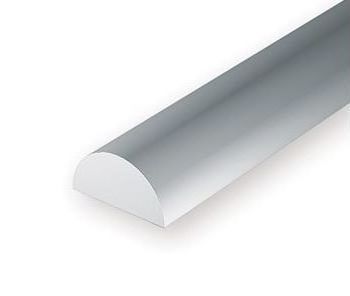
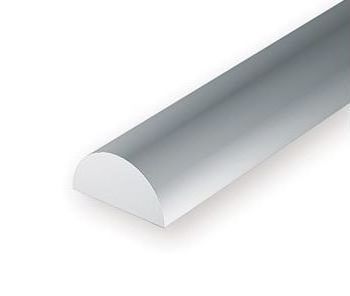
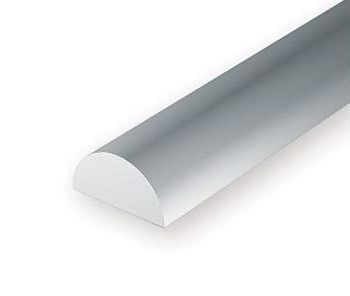
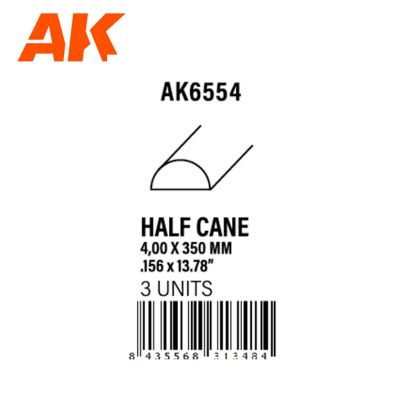
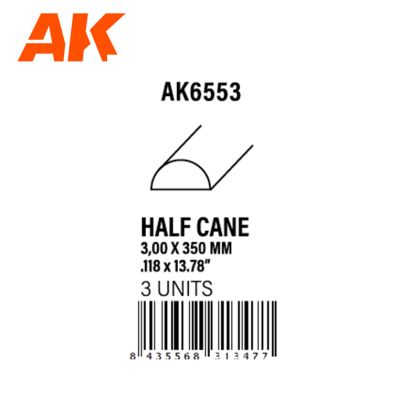
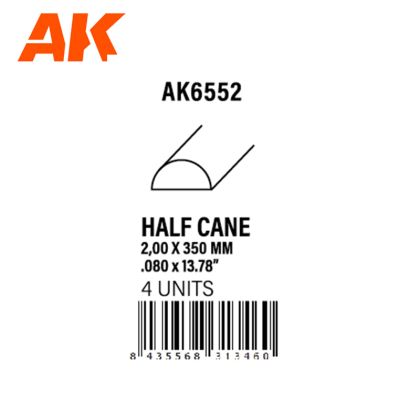
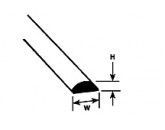
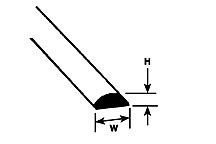
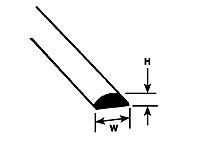
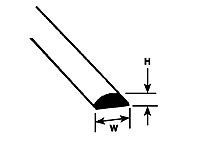
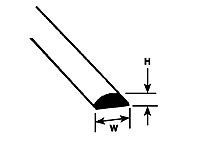
The half-round profile has one flat face and one curved, so once glued to a surface it reads as a raised moulding or as a pipe half-sunk into the panel. That makes it the quickest way to add a hose, a conduit cover, a longitudinal boss or a decorative strip to a model.
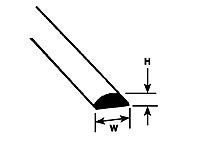
Widths run from one and a half millimetres to six and a half, the height is about half the width, and lengths are 250 or 350 mm. The flat face also means the piece stays exactly where you put it while the cement grabs.
Round rod glued to a flat surface touches along a single line, so it rolls as you position it and the joint is weak. Half-round beds down on its whole flat face, holds itself in place, and the result looks like a pipe half-recessed into the panel, which is exactly how hoses sit inside covers and cables under trunking.
The commonest job. A longitudinal moulding on a superstructure, a cable cover on a building wall, a surround to a hatch, a stiffening rib on a plate. A width of about two millimetres reads in 1:35 as a cover some seven centimetres across, which is a typical size.
Where a hose simply lies along a surface and leads nowhere, half-round is quicker than tube. Two pieces glued side by side make a twin run. For hoses that have to loop out into space, reach for wire and rod instead.
Short offcuts work as longitudinal bosses, feet under brackets and rounded ends on struts. If the moulding has to sit in a corner rather than on a face, the quarter-round profile takes over.
A finished moulding only reads properly once the shadow around it is emphasised, which is what the products under weathering are for.