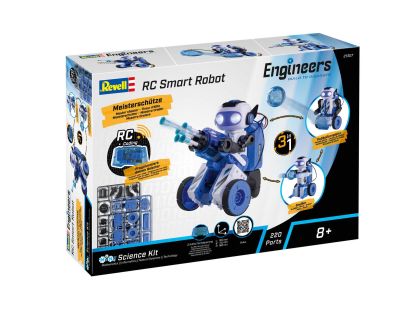
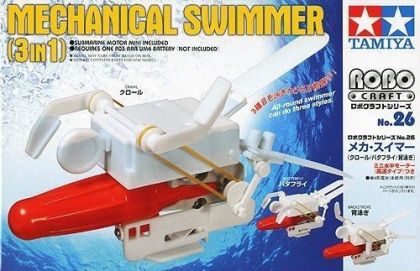
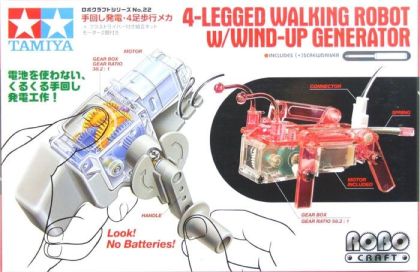
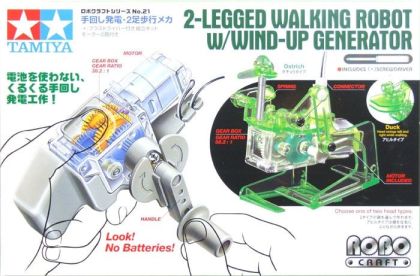
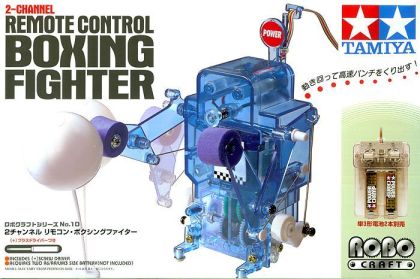
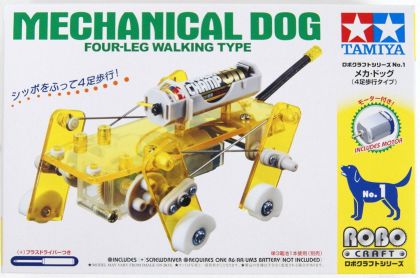
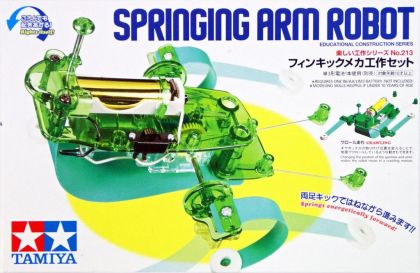
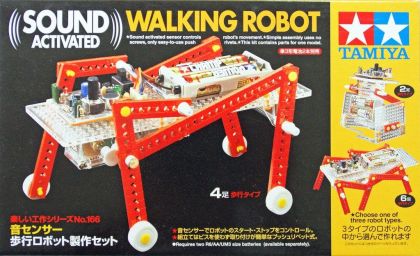
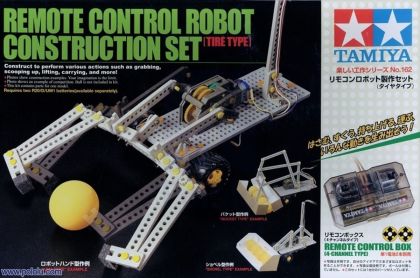
A mechanical robot kit is the most legible mechanics lesson you can put on a table. This part of the RC section holds two-legged and four-legged walking mechanisms, swimming models, a boxing robot on radio control and sets driven by a wound spring or a hand-cranked generator. Most are assembled from loose parts to a printed sequence, so building one walks you through the entire drive train from power source to limbs.
Below: what these models actually do, how the power source changes the experience, and where a walker will and will not work.
These are not programmable toys with a screen. The movement comes from mechanics: a spring, a small electric motor or a crank generator turns a gearbox, which converts rotation into steps, a swimming stroke or a punch.
The range covers walking two- and four-legged models, swimmers and animal mechanisms, a model that reacts to sound, and a robot on two-channel radio control. Some sets take the form of a construction kit that can be dismantled after the first build and reassembled differently.
Wind-up and hand-crank models need no batteries at all — wind, set down, watch. Models with a motor and cells run longer and quieter. The radio-controlled version is the most fun for children but has the most parts that can break.
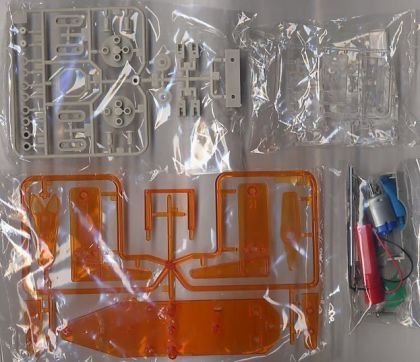
Simpler sets go together in an evening and the instructions work from pictures alone. Construction kits with interchangeable modules take several hours and demand patience when seating small gears. Building with a child, expect the hardest part to be tightening screws just enough that a shaft still turns freely.
Walking models need a hard, level surface — on carpet they lie down immediately. Swimmers want a bath or a paddling pool where nothing can go wrong. Before the first launch, check that the battery compartment really is closed.
If watching parts come together into a working whole is the appeal, try 3D puzzles or RC cars next; both rest on the same step-by-step assembly. The whole branch is in RC models and chuck gliders.