Collections get built in 1:72, and several aircraft of one unit will share a shelf, which is what makes this the busiest aircraft scale of all. The sheets stay with documented machines and episodes: carrier torpedo bombers, dive bombers across several theatres, Soviet biplanes in their own and in captured service, American carrier fighters and their British counterparts, and twin-engine aircraft in less usual roles. Sets contain the printing alone, with no kit, paints or varnish in the packet, and you choose by the type and version of the aircraft you are building.
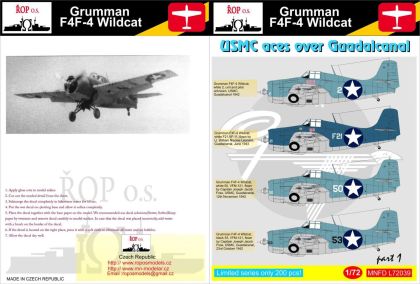
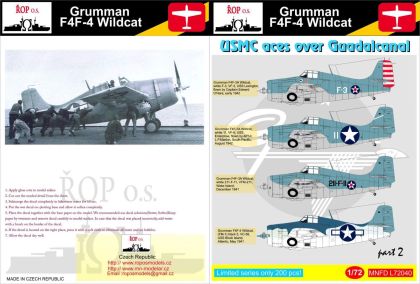 1:72 Grumman F4F-4 Wildcat - USMC aces over Guadalcanal
7.96 €
1:72 Grumman F4F-4 Wildcat - USMC aces over Guadalcanal
7.96 €
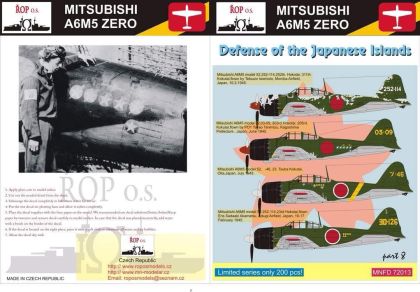 1:72 Mitsubishi A6M5 Zero Model 52 - Defense of the Japanese Islands
7.96 €
1:72 Mitsubishi A6M5 Zero Model 52 - Defense of the Japanese Islands
7.96 €
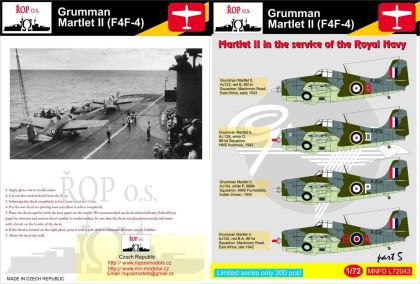
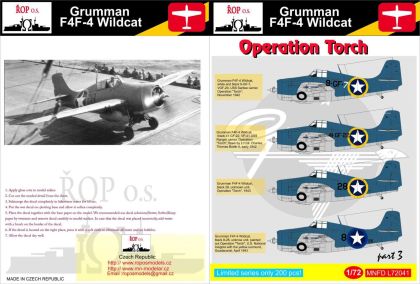
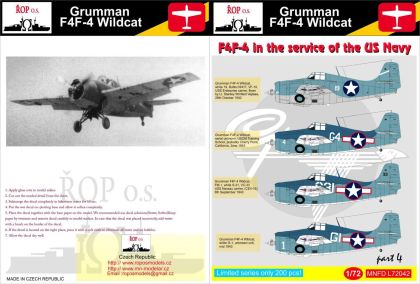 1:72 Grumman F4F-4 Wildcat - F4F-4 in the service of the US Navy
7.96 €
1:72 Grumman F4F-4 Wildcat - F4F-4 in the service of the US Navy
7.96 €
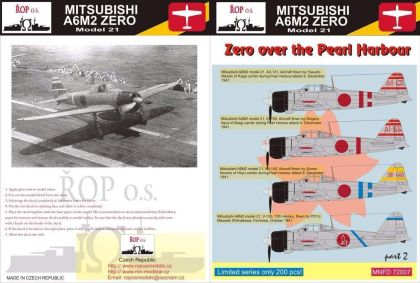 1:72 Mitsubishi A6M2 Zero Model 21 - Zero over the Pearl Harbour
7.96 €
1:72 Mitsubishi A6M2 Zero Model 21 - Zero over the Pearl Harbour
7.96 €
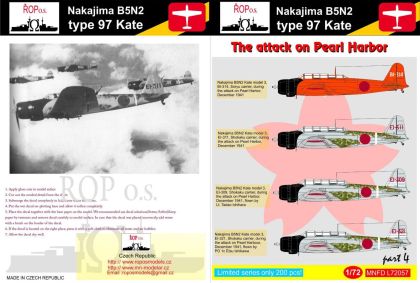
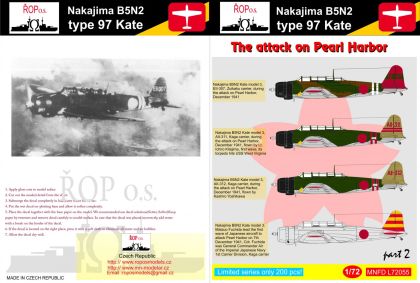
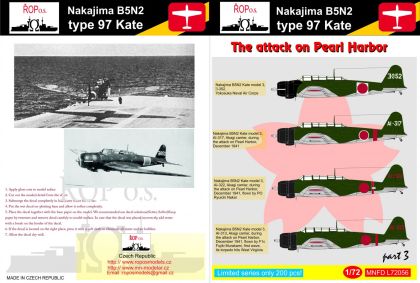 1:72 Nakajima B5N2 type 97 Kate - The attack on Pearl Harbour
7.96 €
1:72 Nakajima B5N2 type 97 Kate - The attack on Pearl Harbour
7.96 €
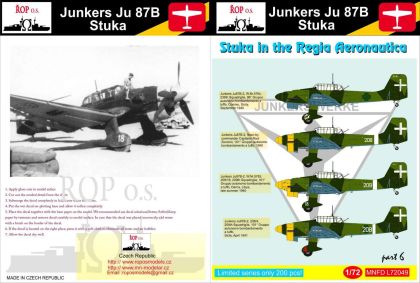
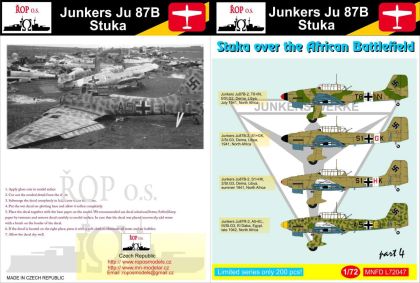
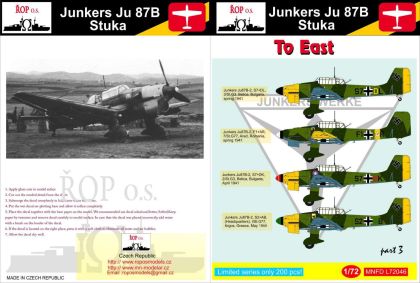
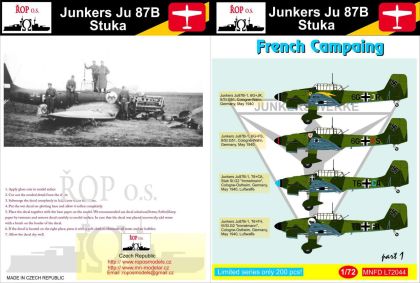
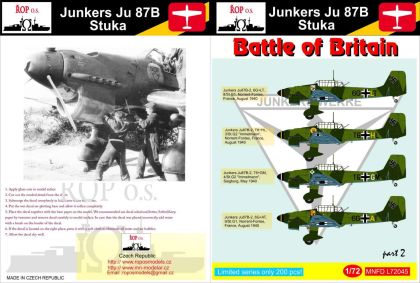 1:72 Junkers Ju 87B Stuka - Battle of Britain
7.96 €
1:72 Junkers Ju 87B Stuka - Battle of Britain
7.96 €
A fighter has a wingspan of about fifteen centimetres here, so the markings are small without being microscopic. The advantages are storage and the chance to build a run of machines from one unit and follow the differences in their markings. The drawback is that on small surfaces the edge of the carrier film gives itself away easily if the gloss base has been neglected.
The printing is tied to a version, not merely to a type. On carrier fighters and on dive bombers alike, the panels that carried the markings differed between variants, so read the version designation in the sheet name.
This scale invites series. One type in several schemes, or one theatre across several types: either works far better than sheets bought at random, and it is the reason small-scale shelves tend to look more coherent than large ones.
Markings and camouflage have to belong to the same date. Choose the scheme first and mix the shades to suit it, rather than the other way round.
Not on applying the decals, oddly enough, but on preparing the surface. Large national insignia on a wing have to go down on smooth gloss with no grain in it, or the edge will never vanish. It pays to polish the gloss coat with a very fine sanding sponge and remove the dust before you start. The application itself then takes a few minutes and the result looks like painted markings rather than stickers.
Larger-scale sheets are in 1:48, and the full aircraft range is under ŘOP aircraft decals.